

![[FBM] CARDS](https://cpa.rip/wp-content/uploads/cr-a1/fbm-cards-v1/fbm-cards-logo.svg)

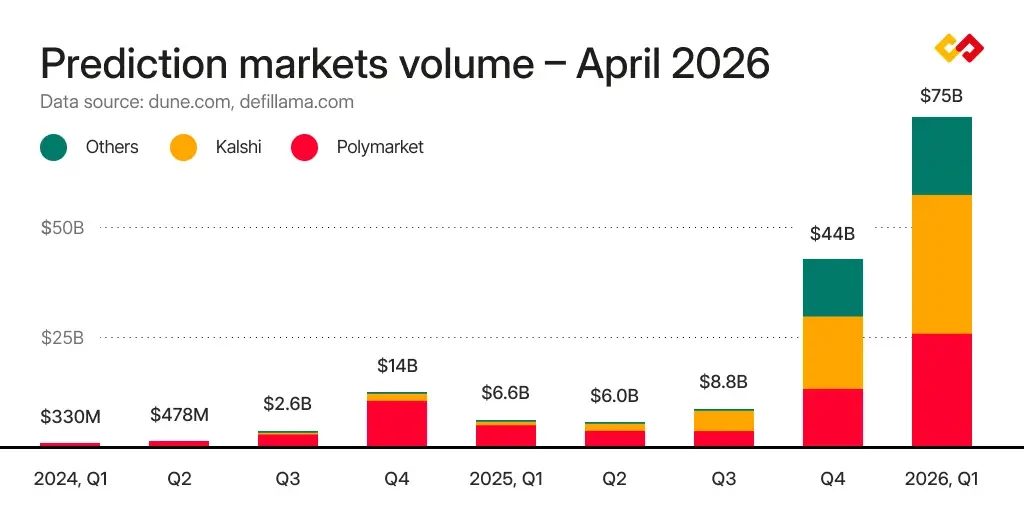
Over the past two years, prediction markets have evolved from a niche phenomenon into a major market with turnover in the tens of billions of dollars. In the first quarter of 2026 alone, trading volume reached $75 billion. Here is how these platforms work, how event outcome contracts differ from regular bets, and how operators make money.
What Are Prediction Markets
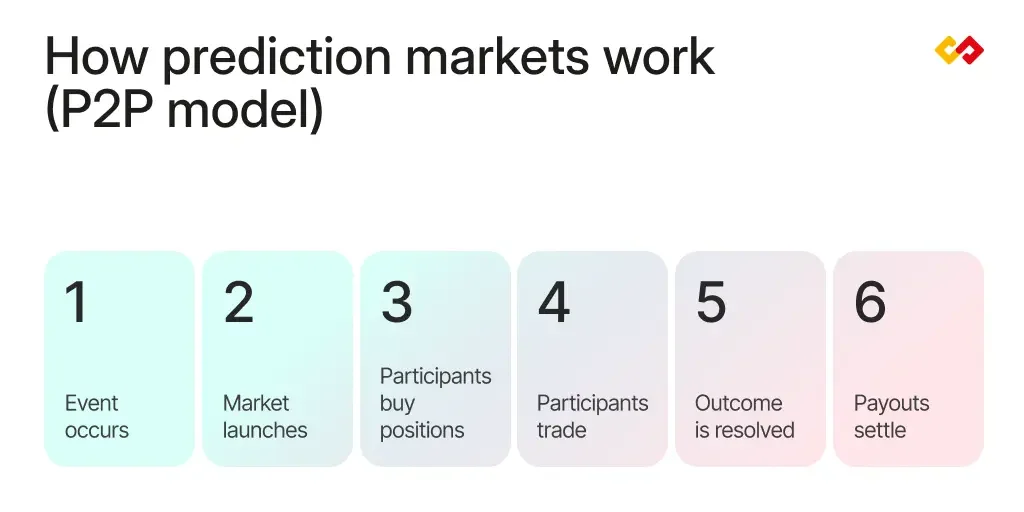
A prediction market is a trading venue where people put money behind their expectations of what will happen in the future. Events are typically framed as simple questions with a “yes” or “no” answer, and participants can buy a position that pays out if their forecast is correct.
The key feature is that the contract price is set not by the platform but by the participants themselves. The price changes based on how much money participants are willing to put behind a particular outcome, so at any given time, the market reflects the collective assessment of an event’s probability.
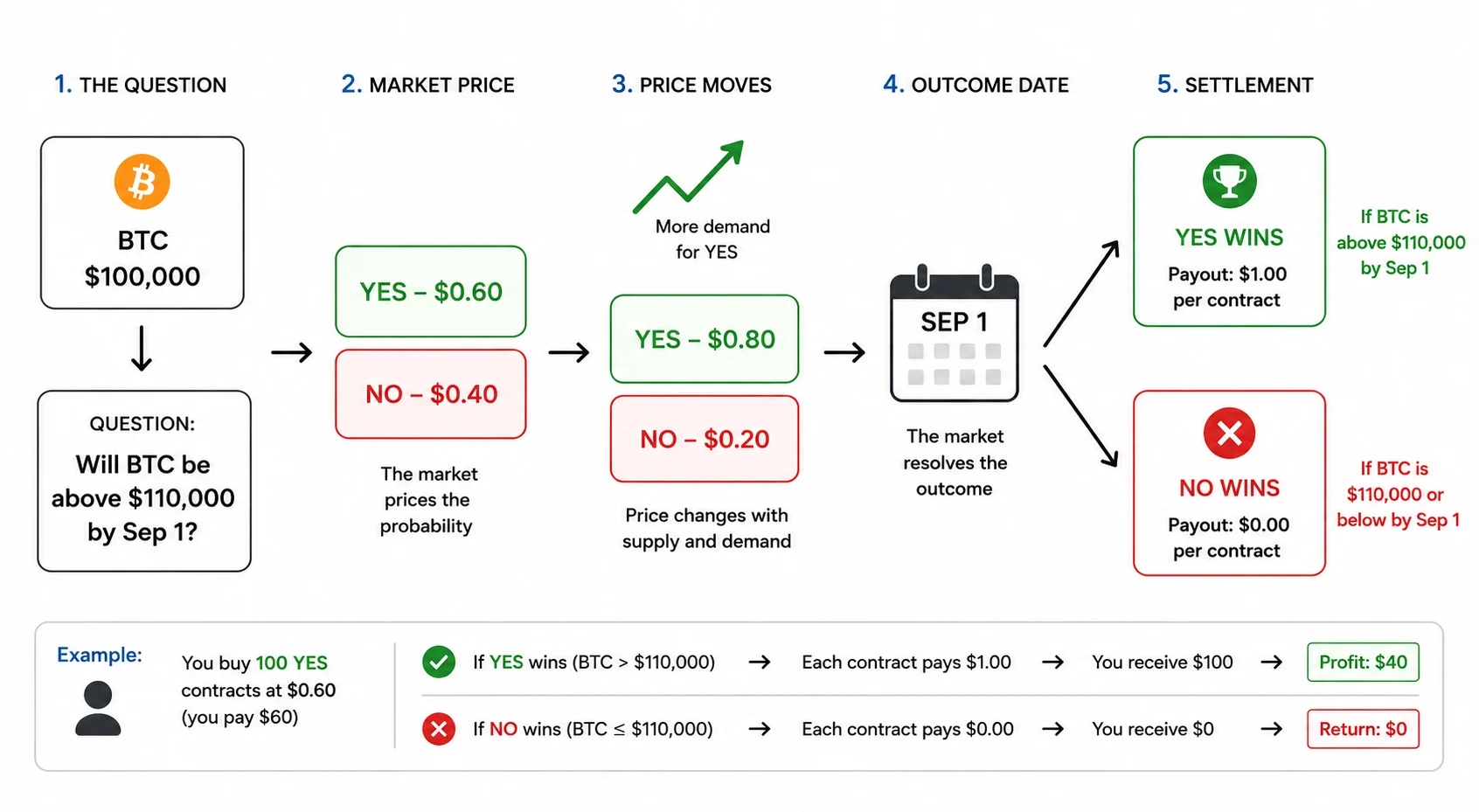
Example. Suppose the following question is created: “Will BTC be above $110,000 by September 1?” A YES contract costs $0.60, which can roughly be interpreted as the market estimating a 60% probability of the event. You can buy any number of these contracts: for example, 100 contracts will cost $60. If Bitcoin is above $110,000 by the specified date, each contract pays $1, for a total of $100 and a $40 profit. If the event does not happen, the contracts become worthless. You do not have to wait for the settlement date, though: if the contract price rises, for example, from $0.60 to $0.80, you can sell 100 contracts for $80 and lock in a $20 profit.
The price changes due to supply and demand. If market participants become more confident that Bitcoin will reach $110,000, they start buying YES contracts, and their price rises, for example, from $0.60 to $0.75. If expectations worsen and participants start selling YES contracts, the price falls, for example, from $0.60 to $0.40. This is why a contract’s price constantly reflects how the market currently assesses the probability of an event.
The idea itself is older than it may seem: in 16th-century Europe, people bet on papal elections, and in the early 20th century, Wall Street had betting pools on US presidential elections, with their odds published by the New York Times. The internet merely brought this mechanism back and removed intermediaries.
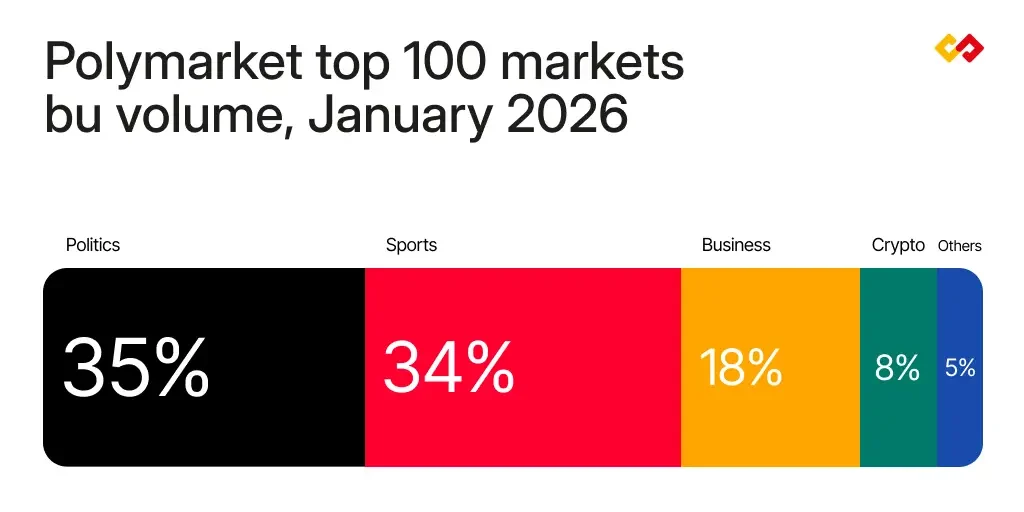
You can trade on any events:
- politics and elections;
- the economy and recessions;
- cultural events and show business;
- weather and natural phenomena;
- sports and esports;
- topics proposed by users themselves.
These platforms are designed for short sessions: you log in, check the quotes, buy a contract, and leave. By operating model, they are divided into centralized platforms (Kalshi, where the company manages user accounts and determines outcomes) and decentralized platforms (smart contracts without a central intermediary).
How Prediction Markets Differ From Sports Betting
Visually, everything looks similar: an event feed, odds, and a “place a bet” button. But the mechanics behind the money are fundamentally different.
At a sportsbook, the player bets against the operator: the operator sets the odds, builds in a margin, and manages payouts. You can exit a bet only through cashout, and the operator determines the exit price, usually at a discount.
In a prediction market using a P2P model, participants trade directly with one another: contracts can be freely bought and sold before the outcome is determined, and you can profit by selling a contract for more than you paid for it. In the fixed odds model, the player bets against the platform, but the odds are calculated based on probability and fixed when the bet is accepted.
Criterion | Prediction markets (P2P) | Prediction markets (fixed odds) | Sportsbook |
Model | Trading between participants | Betting against the platform | Betting against the operator |
Odds | Set by the market | Calculated and fixed when the bet is placed | Set by the operator |
Exiting a position | Sale at the market price | Cashout | Cashout with an operator discount |
Events | Any: politics, economy, culture | Politics, economy, culture, sports | Mostly sports |
Seasonality | No | No | Yes |
Prediction Market
Prediction markets have existed for a long time, but 2025 marked their period of broad recognition, while the growth trigger was the 2024 US presidential election, when Polymarket and Kalshi showed that event trading could attract a mass audience. By the end of 2025, activity volume on the largest platforms exceeded $44 billion.
In the United States, markets are classified as financial products and operate under CFTC oversight. In March 2026, lawmakers introduced the Prediction Markets Are Gambling Act, which could reclassify event trading as gambling activity. Europe has no unified approach: most countries treat prediction markets as gambling, while Gibraltar became the first to issue a license, granted to Predict Street, which is preparing markets for FIFA 2026.
Region | Classification | Status | Notes |
United States | Financial (derivatives) | Partially regulated | Possible reclassification under gambling laws. |
Canada | Mixed | Gray area | Allowed everywhere except Ontario (banned since 2025). Assessed as derivatives/securities. |
European Union | Varies (often gambling) | Mostly restricted | No unified rule; banned in many countries (France, Italy, etc.). |
United Kingdom | Gambling | Regulated | Considered betting and requires a Gambling Commission license. |
Asia | Gambling | Mostly restricted | Singapore has blocked access, while Thailand is imposing restrictions. |
Oceania | Gambling | Restricted | Banned in Australia and New Zealand. |
South America | Gambling / unclear | Mostly restricted / gray | Argentina and Brazil have banned them; Chile and Peru are gray areas. |
Africa | Unclear | Gray area | There is little clarity, but regulatory attention has been growing since 2026. |
Major projects in the market:
- Polymarket is a decentralized P2P exchange on the blockchain, launched in 2020.
- Kalshi is a centralized platform regulated by the CFTC, operating since 2021.
- PredictIt is a smaller P2P platform specializing in politics.
- Manifold is a smaller P2P platform with a broad range of topics.
- Predict Street is the first licensed platform in Europe (Gibraltar, 2026).
How Platforms Make Money and Why People Play
Prediction market monetization is built not on betting margins but on transaction fees: the platform earns from the movement of money, not from a participant’s loss.
- Transaction fees are the main source of revenue: a percentage from every contract purchase or sale.
- Winning fees: some platforms take a percentage of the payout after the event is settled.
- Market creation fees: fees charged to initiators of new topics.
You do not pay for a guaranteed outcome but for the opportunity to express confidence in your forecast and receive a payout if you are right. Most often, contracts are bought to:
- profit from a more accurate probability estimate than the market’s;
- take part in discussions of high-profile events and topics;
- lock in a profit by selling a contract for more than you paid for it;
- test an analytical approach with real money;
- get a quick gambling experience without being tied to a sports schedule.
At the same time, prediction markets cannot be considered completely risk-free. You do not bet against the operator in the traditional sense, but you can lose your invested money if the event does not happen and become accustomed to mechanics that closely resemble gambling.
Main risks:
- the complete loss of a contract’s value if the event fails to happen;
- price dependence on manipulation and the flows of large participants;
- ambiguous determination of a market’s outcome;
- the risk of abrupt regulatory changes;
- developing a habit of quick speculative actions;
- shifting from forecasting to real-money betting.








Comments