

![[FBM] CARDS](https://cpa.rip/wp-content/uploads/cr-a1/fbm-cards-v1/fbm-cards-logo.svg)

What social casinos are, how they’re structured, how they make money, and how they differ from regular online casinos. We also looked at why users buy virtual coins with no cash-out option and what specific features this model has.
A social casino is a game built on casino mechanics that uses virtual coins or chips. It can include slots, poker, bingo, roulette, blackjack, tournaments, and leaderboards.
The key difference from a regular online casino is that the player doesn’t wager real money and can’t cash out any winnings. Instead of money, the game uses virtual coins or chips, which can be earned for free or purchased inside the app.
They can be obtained:
- for logging in daily;
- for completing tasks;
- for winning in-game;
- for taking part in tournaments;
- through bonuses and promo codes;
- through in-app purchases.
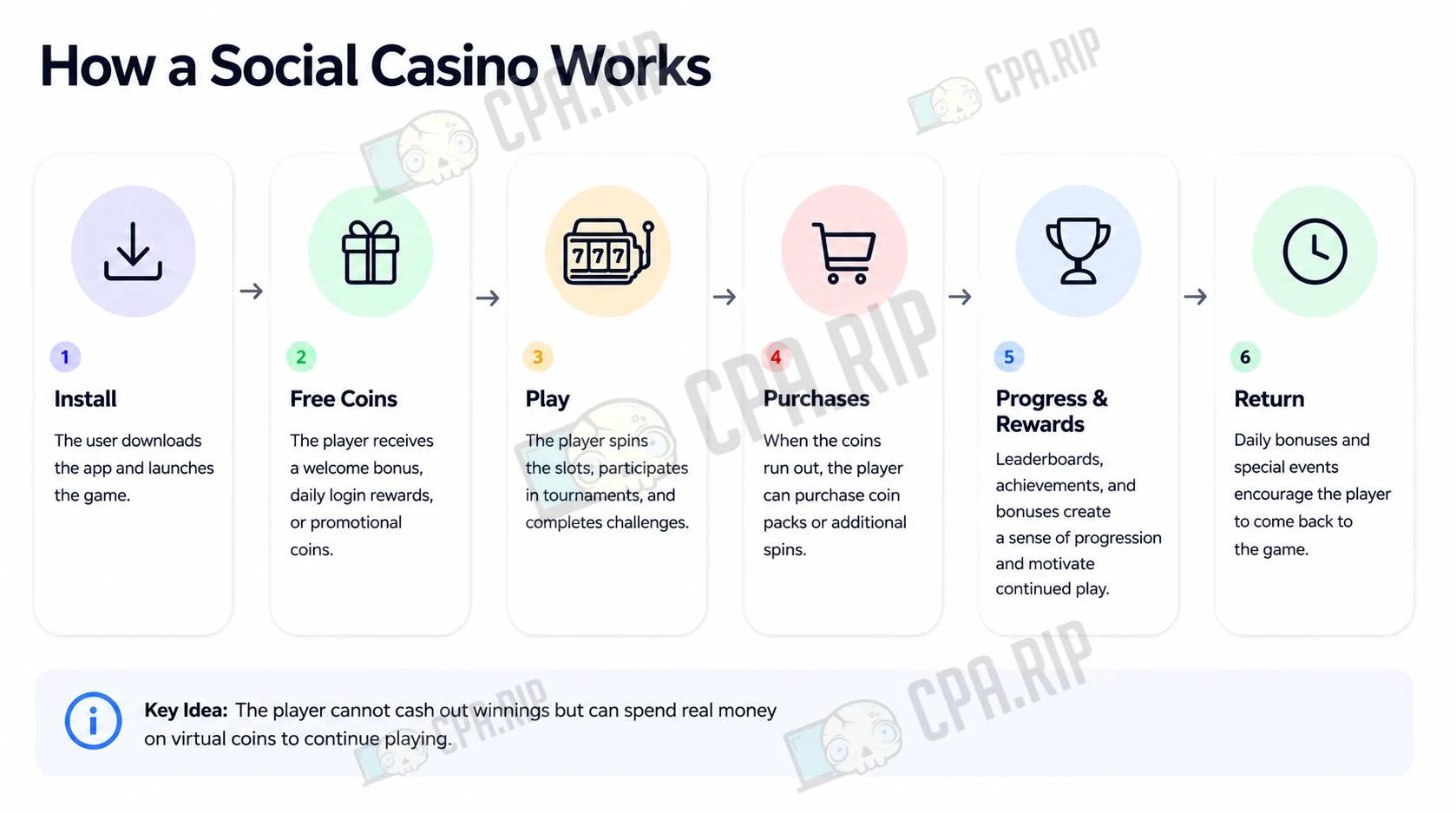
These apps are designed for short sessions. A user opens the app for a few minutes, grabs a bonus, makes a few spins, checks the leaderboard, and leaves. It’s similar to the habit of opening a social media app or a mobile game out of boredom.
In the UK, according to the UK Gambling Commission, 30-34% of players aged 18-34 cite boredom as one of the reasons they play. For social casinos, this is an important use case: they offer a quick gambling-style experience without an actual real-money wager.
Social casinos are often confused with online casinos and sweepstakes casinos. Visually they look alike: slots, bonuses, chips, reels, jackpots. But in terms of money and rules, these are different products.
In an online casino, the user deposits real money, places bets, and can withdraw winnings.
In a social casino, the user plays with virtual coins. They can buy additional coins, but they can’t withdraw any winnings.
A sweepstakes casino is a separate model, more common in the US. It usually has two currencies: one for entertainment, and another that may be tied to sweepstakes draws or prizes. In Europe and the UK, this model falls under gambling regulation if it involves payment, chance, and a real prize.
| Criterion | Social Casino | Online Casino | Sweepstakes Casino |
|---|---|---|---|
| Model | Free-to-play with casino mechanics | Real-money gameplay | Hybrid of gameplay and promo mechanics |
| Currency | Virtual coins | Real money | Usually two currencies |
| Deposits | ✅ Coin purchases | ✅ Deposit | ✅ Package purchases |
| Cashing Out Winnings | ❌ No | ✅ Yes | ⚠️ Sometimes* |
| Platform Revenue Source | Purchases, ads, subscriptions | Casino margin | Sale of virtual packages |
| Legal Status | Usually not classified as gambling | Regulated gambling | Depends on jurisdiction |
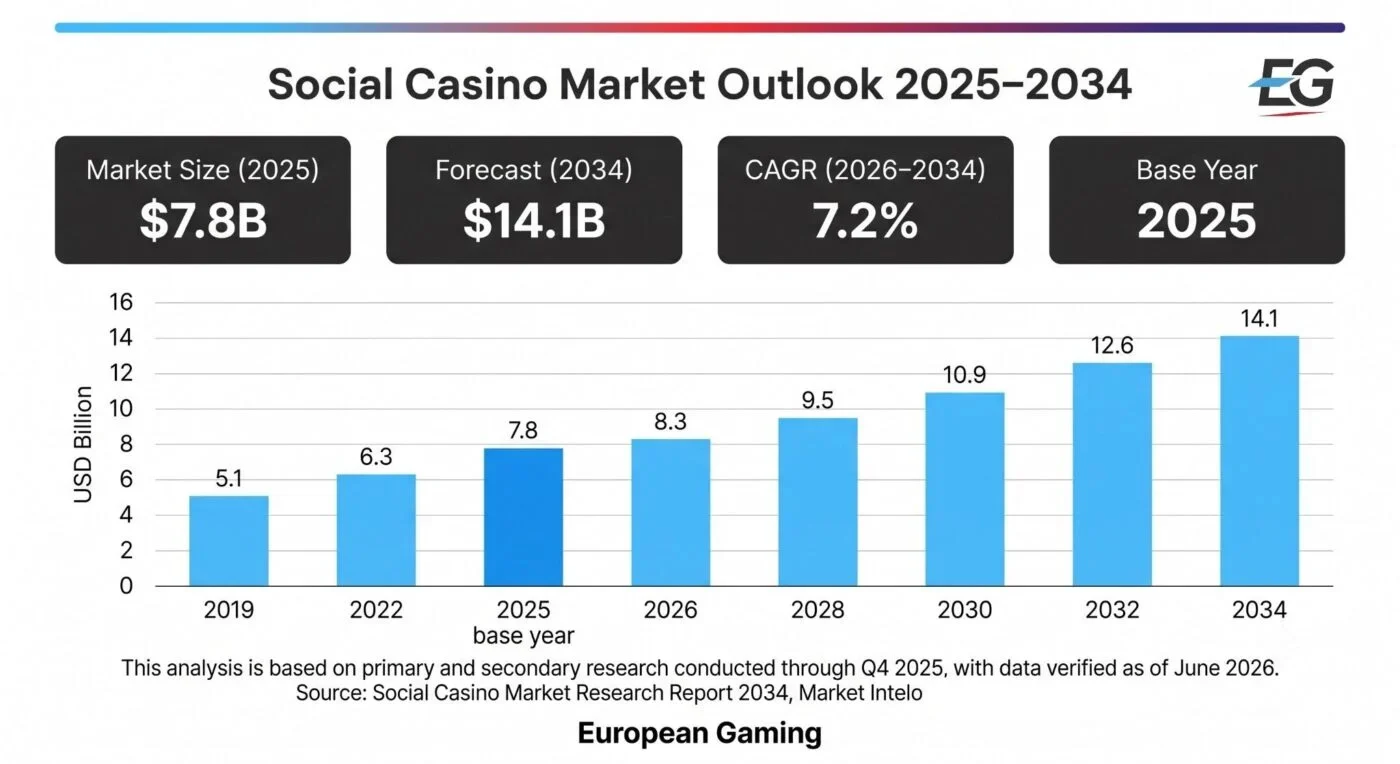
According to Market Intelo, the global social casino market is valued at $7.8 billion in 2025 and is expected to grow to $14.1 billion by 2034. Meanwhile, according to Grand View Research, 40% of the market’s revenue comes from North America, and the European market will grow from $1.56 billion in 2024 to $2.43 billion by 2030. Finland is considered one of the most profitable markets in the EU.
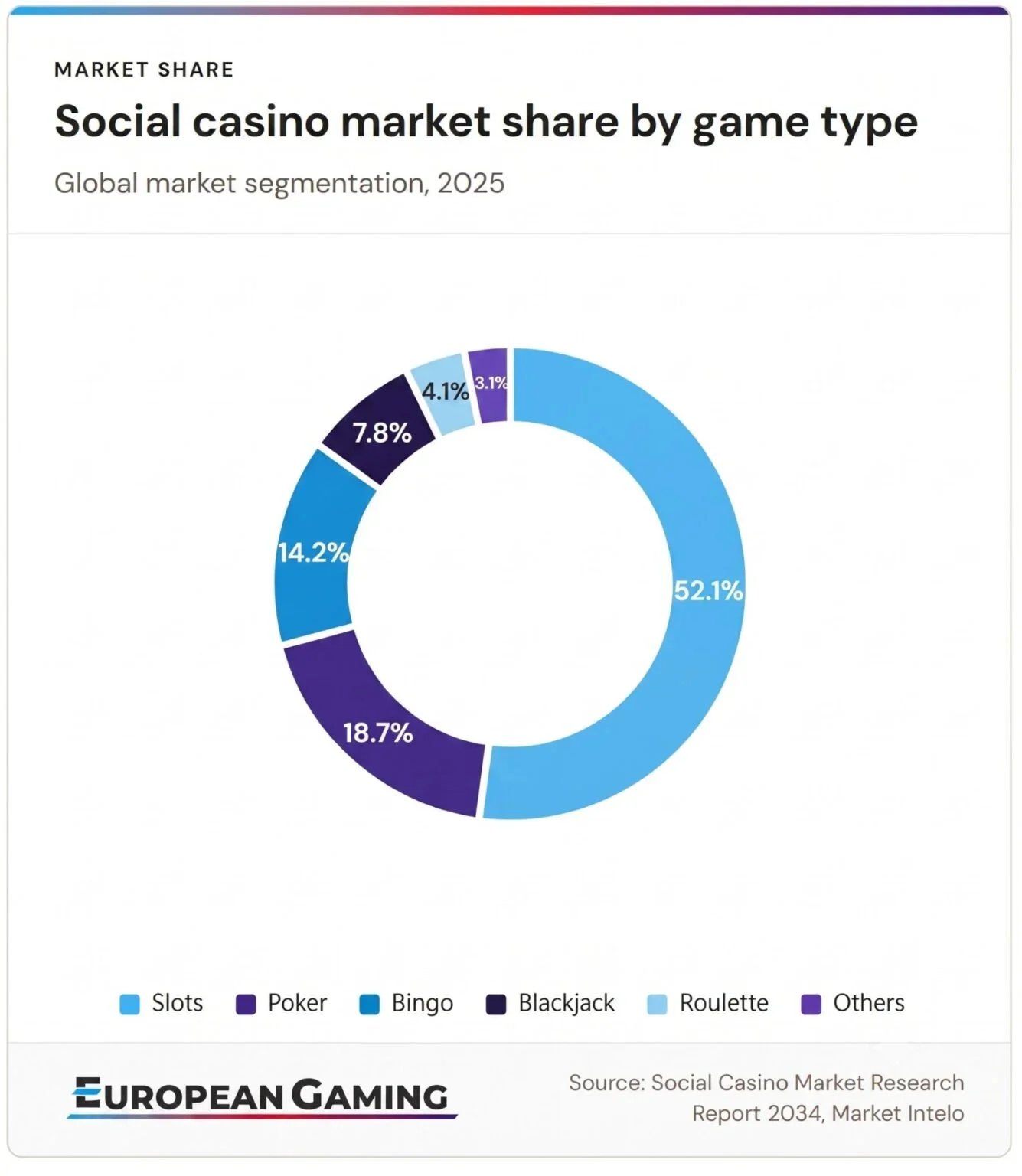
Slots dominate the social casino market structure, accounting for 52.1% of the segment. They’re followed by poker at 18.7%, bingo at 14.2%, blackjack at 7.8%, roulette at 4.1%, and other games at 3.1%.
There are major players in the market that illustrate how the social casino model works. Playtika releases free-to-play games featuring virtual currency, bonuses, and progression, including titles like Dice Dreams, Vegas Words, and Animals & Coins. Aristocrat, through Product Madness, develops social casinos built on slot mechanics: the company’s portfolio includes more than 100 games, including Heart of Vegas, Cashman Casino, and Lightning Link. Huuuge Games focuses on quick sessions and social features: Huuuge Casino has racked up more than 80 million downloads, while Billionaire Casino has topped 50 million.
Unlike regular online casinos, the core monetization model of social casinos isn’t built on cash wagers and payouts — their model is closer to mobile games, and the main revenue comes from in-app purchases.
According to industry estimates, these purchases generate 64.8% of social casino revenue. Users buy coins, extra spins, premium packages, subscriptions, or ad-removal options.
Advertising accounts for another 26% of revenue. It appears between rounds or in a rewarded video format, where the user watches a clip and receives a bonus for it.
In a social casino, the user isn’t paying for a chance at a cash payout — they’re paying to continue and speed up the gameplay. Most often, coins are purchased to get a few more spins, clear a level faster, unlock a bonus mode, join a tournament, or stay ahead of other players on the leaderboard.
That said, social casinos can’t be considered entirely risk-free. The user doesn’t wager real money and doesn’t withdraw winnings. But they can spend real money on virtual coins and grow accustomed to mechanics that closely resemble gambling.
Key risks include:
- frequent coin purchases;
- losing track of time spent in the game;
- pressure from daily bonuses and limited-time promotions;
- getting used to slot mechanics;
- playing as a way to cope with boredom or stress;
- transitioning to real-money gambling.
Sheffield Mind reported that 19% of players believe social casinos influenced their decision to move on to playing with real money.








Comments