

![[FBM] CARDS](https://cpa.rip/wp-content/uploads/cr-a1/fbm-cards-v1/fbm-cards-logo.svg)

What happens if you take an offer with no existing data and drive nearly $700k to it? Our in-house buying team at Riddick’s Partners tested it with its own budget.
We started with an Australia offer that had no accumulated data, proven traffic sources, or a clear answer to the affiliates’ main question: “How much can an actual deposit cost here, and can volumes be scaled?”
In this case study, we explain how we built the media buying process, what happened to conversion rates month by month, and why we invested that much money into an untested offer in the first place.
Why we drive traffic to new offers ourselves first
Before the first major traffic push, a new offer has too little data to assess its real potential. For example, how the audience will respond to it, where the funnel will start to drop off, and what CPA you can achieve at real volume.
We prefer to get answers to these questions before our partners start running the offer. That is why our in-house team handles the first stage: it drives traffic, gathers data, identifies weak points, and works with the advertiser to refine the product as traffic comes in. As a result, partners receive an offer that has already been tested and improved.
How we prepared for the traffic launch
- Team: Riddick’s Partners in-house buying team
- Traffic period: 01.01 – 30.06
- Offer: Exclusive
- GEO: Australia
- Source: influencers (90%+)
- Spend: $686K
- FD: 4 111
- CPA: $167
Before launch, our team reviewed the core inputs: we assessed product-market fit, product and SEO results page readiness, analyzed competitors, and estimated which sources and formats could be bought effectively in Australia. Then we began bringing in users and tracking their actions from their first interaction with the brand through to a deposit. But the goal was not simply to collect deposits. We needed to understand what was already working in the product and what needed to be fixed before volumes increased.
More than 90% of the volume went to influencers
Influencers became the main source, accounting for more than 90% of the campaign. We selected standout creators with strong audience trust, which is almost impossible without thorough research and a deep understanding of the GEO. When buying placements, we looked at reach, engagement, and the blogger’s connection with their audience. Instagram, YouTube, and Snapchat were the main platforms, and we often ran integrations across all of a creator’s channels at once.
We kept integrations as native as possible, using the blogger’s usual style, personal experience, emotion, and a simple CTA. However, branding was mandatory in every publication, so users could see the product name even without clicking. This helped build brand awareness and gave users the opportunity to find it later through other channels.
Reg2Dep increased at volume, even though registrations became more expensive
We did not use additional warming, meaning we sent traffic directly from the integration to the offer. During the first two months, we gradually increased volumes and monitored the funnel, registration cost, FD, and conversion between stages.
At the same time, we collected feedback from comments and messages sent to influencers. With this source, questions and objections often go directly to the blogger rather than support. We used this feedback as an additional data source and worked with the advertiser’s team to analyze negative scenarios and improve onboarding and retention. As a result, we were able to resolve some issues before the offer was released to partners.
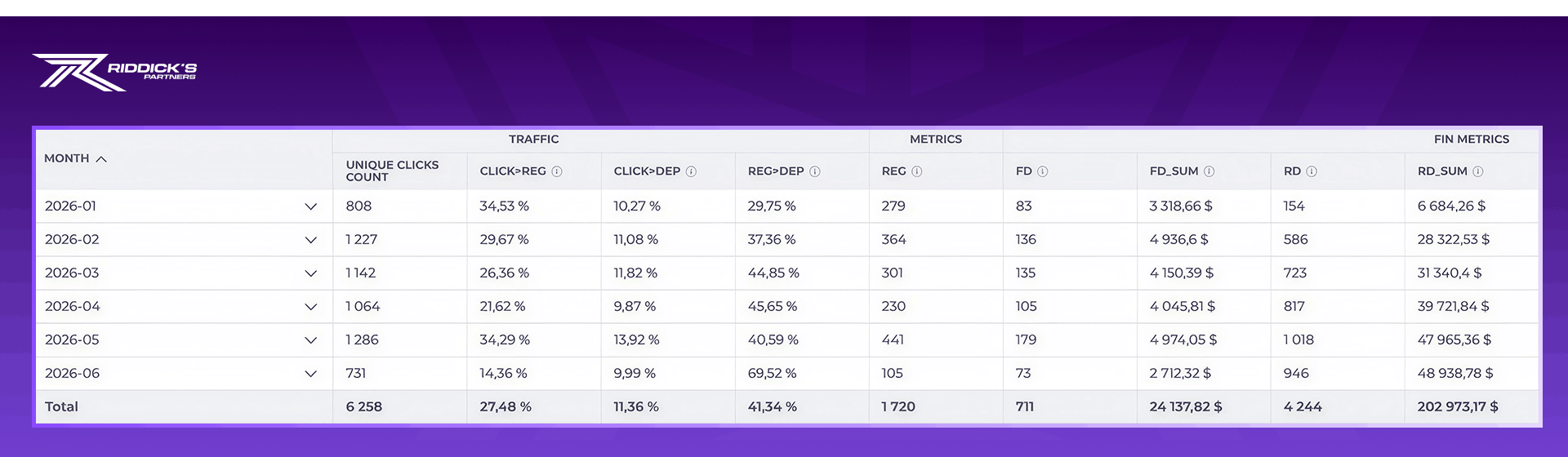
By the third month, registrations had become more expensive, but Reg2Dep started to rise. Repeat integrations and retention worked well, as some users did not deposit immediately but returned and reached FD later. As a result, the increase in registration cost did not drive up deposit CPA at the same rate.
Closer to the end of the cycle, we reduced publication frequency but did not cut off influencers entirely. Repeat touchpoints continued to bring the audience back, but maintaining the previous buying pace no longer made sense.
Direct conversion rates did not show the full impact of influencers
A user could see the brand with a blogger several times, not click the link, and then find the product independently through search a few days later. For direct attribution, that user is already lost, even though their first touchpoint came from the influencer. That is why, alongside conversion rates, we monitored branded traffic. As traffic volume increased, a noticeable tail began to form there, amounting to 30-38% of the number of users directly attributed to influencers.
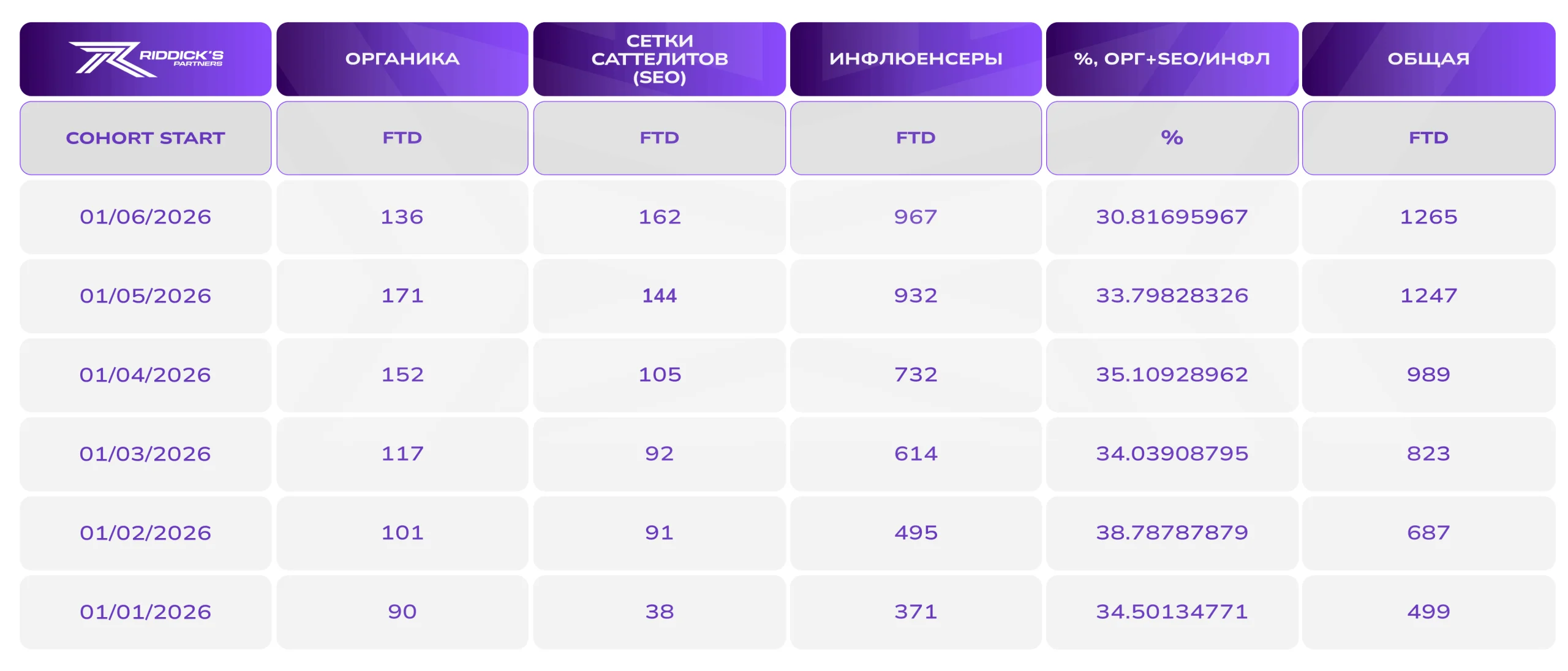
At the same time, we did not add that 30-38% to campaign results or count it as additional FD. The metric instead showed a side effect of the selected approach: influencers generated not only direct clicks but also demand that search picked up later.
After influencers, we tested how other sources converted
Once the product had gained its first users, feedback, and recognition, we began testing how other sources performed with it. We launched tests from June through August and received the following results:
Source | Click → Reg | Reg → Dep |
FB PWA | 25-40% | 20-25% |
In-app | 37-43% | 15% |
PPC | 37-42% | 30% |
ASO | 35% | 20% |
UAC | up to 50% | 15-20% |
Results after six months of traffic buying
From January 1 through June 30, 2026, our in-house team spent $686 000, generated 4 111 FD through direct attribution at an average CPA of $167, and brought in around $1,5 million in deposits. And yes, to reiterate, we did not include the branded effect in the FD count.
But traffic buying figures are only part of the result for us. The main outcome was that we built brand awareness and demand that our partners can pick up and scale through their own traffic sources.
Want to drive traffic to an exclusive offer in Australia? Join Riddick’s Partners. We will provide you with ready-made landing pages and ad creatives, support from managers experienced in affiliate marketing, and the opportunity to scale across 10+ GEOs.
- Join Riddick’s Partners.







Comments