

![[FBM] CARDS](https://cpa.rip/wp-content/uploads/cr-a1/fbm-cards-v1/fbm-cards-logo.svg)

The Federal Bureau of Investigation (FBI) has published its annual Internet Crime Report for 2025. According to the Internet Crime Complaint Center (IC3), total reported losses from submitted complaints exceeded $20 billion for the year. Below are the key facts and figures from the report.
Key findings for 2025
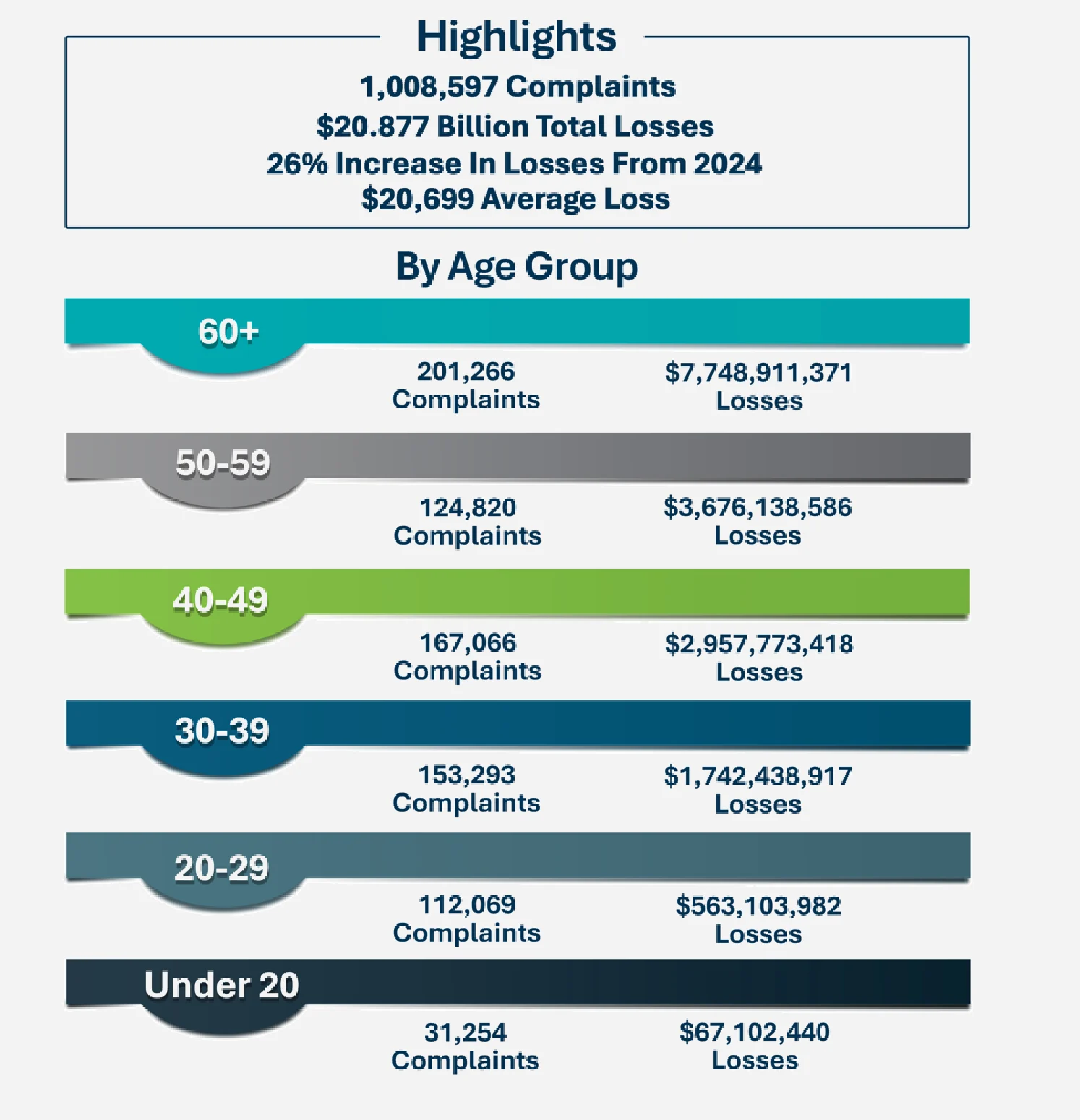
In 2025, IC3 recorded 1,008,597 complaints with total losses of $20.877 billion, which is 26% higher than the 2024 level. The average loss per complaint was $20,699.
People over 60 were hit hardest by scammers, with this group accounting for 201,266 complaints and $7.7 billion in losses. The younger the age group, the lower the total amount of money stolen.
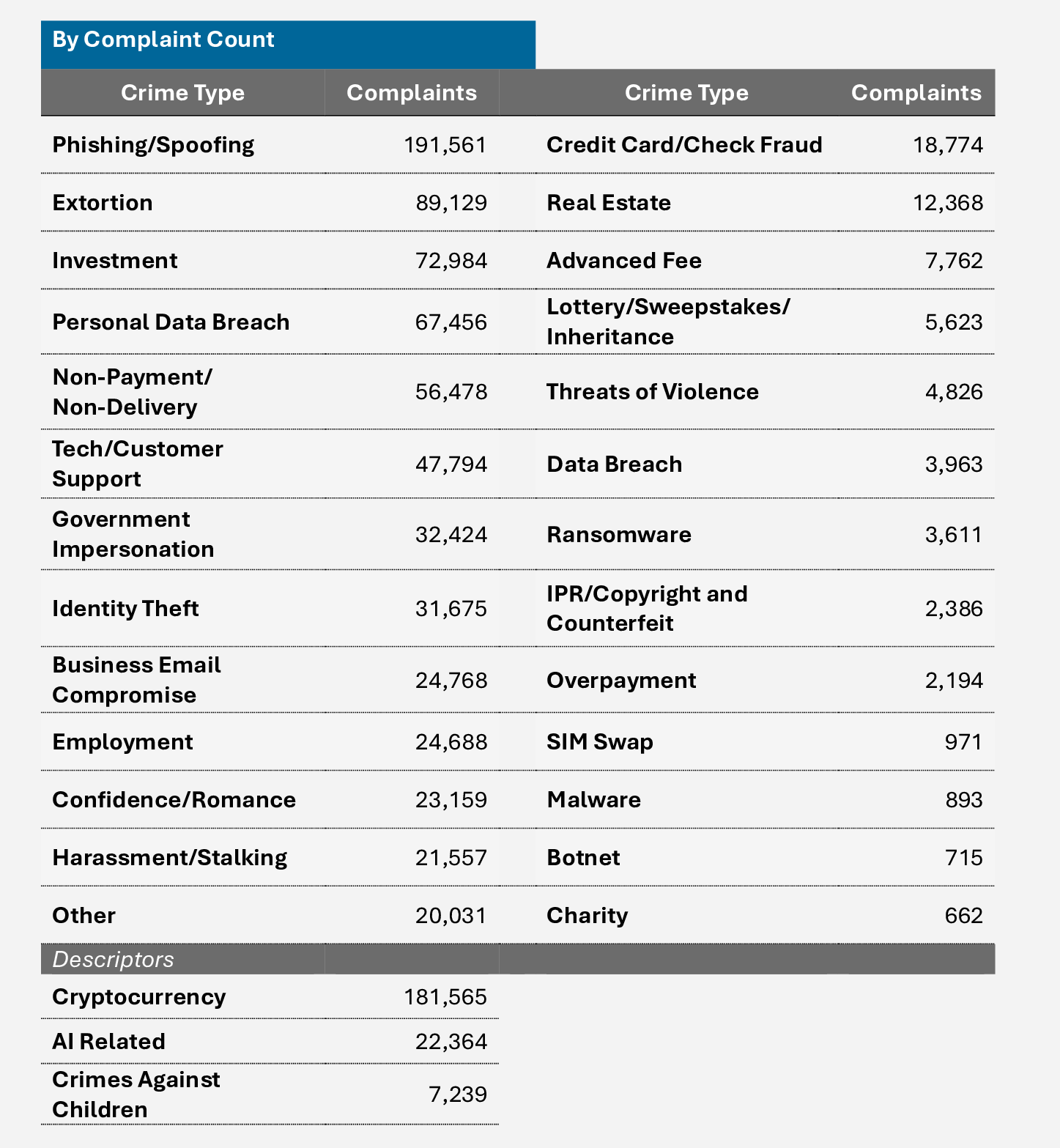
The most common type of fraud was phishing and spoofing, which accounted for 191,561 complaints. Extortion ranked second with 89,129 complaints. Fake investments accounted for 72,984 complaints, while personal data breaches accounted for 67,456.
Phishing and spoofing are attempts to steal data through fake emails or websites.
Cryptocurrency appeared in 181,565 cases, while the use of AI appeared in 22,364.
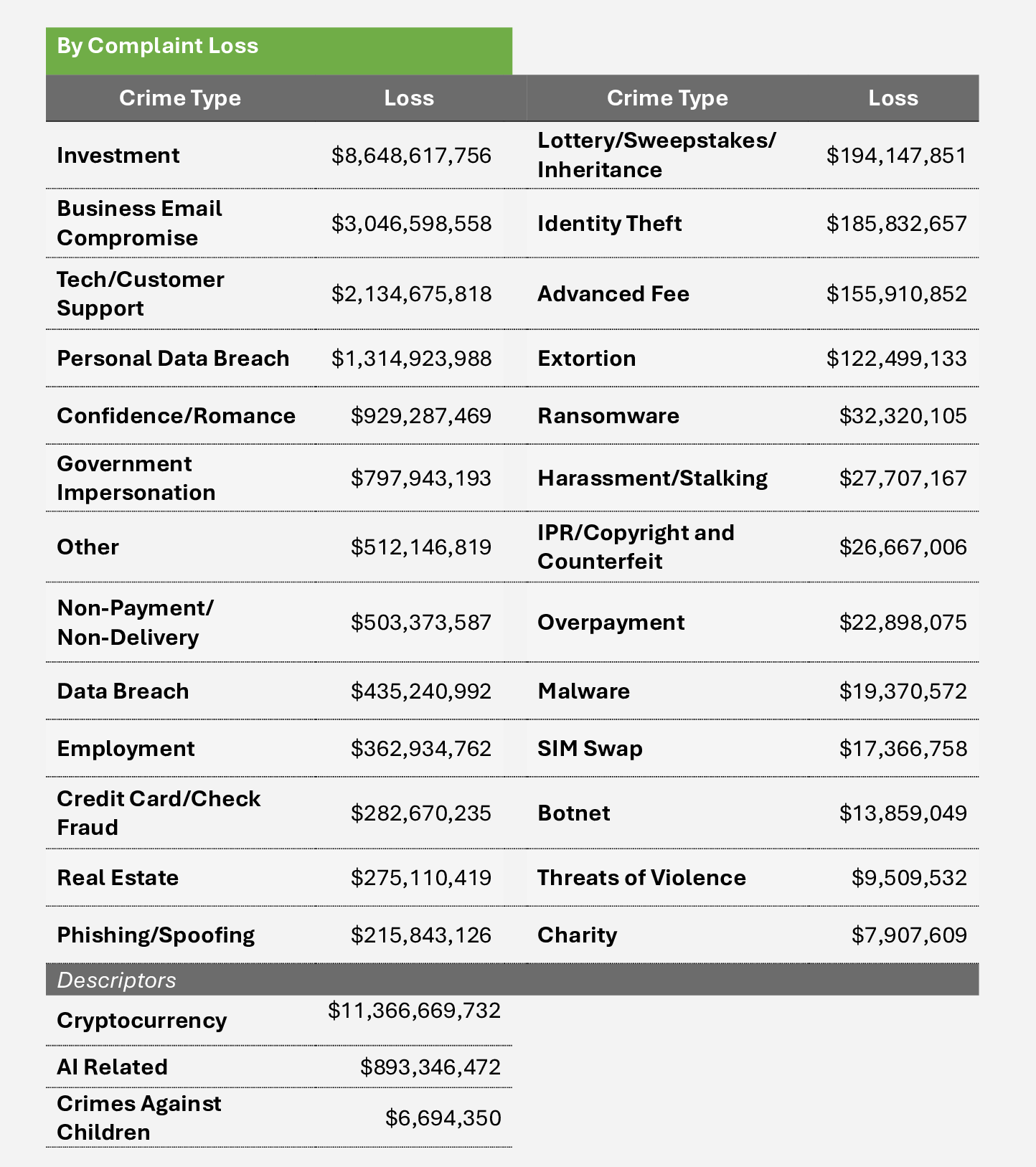
The largest losses came from:
- Investment scams — $8.6 billion
- Business email compromise — $3 billion
- Fake tech support — $2.1 billion
- Personal data breaches — $1.3 billion
- Romance scams — $930 million
Complaints involving cryptocurrency in 2025 resulted in $11.37 billion in losses. The report also separately notes the use of AI in cybercrime: reported losses from such complaints totaled $893 million.
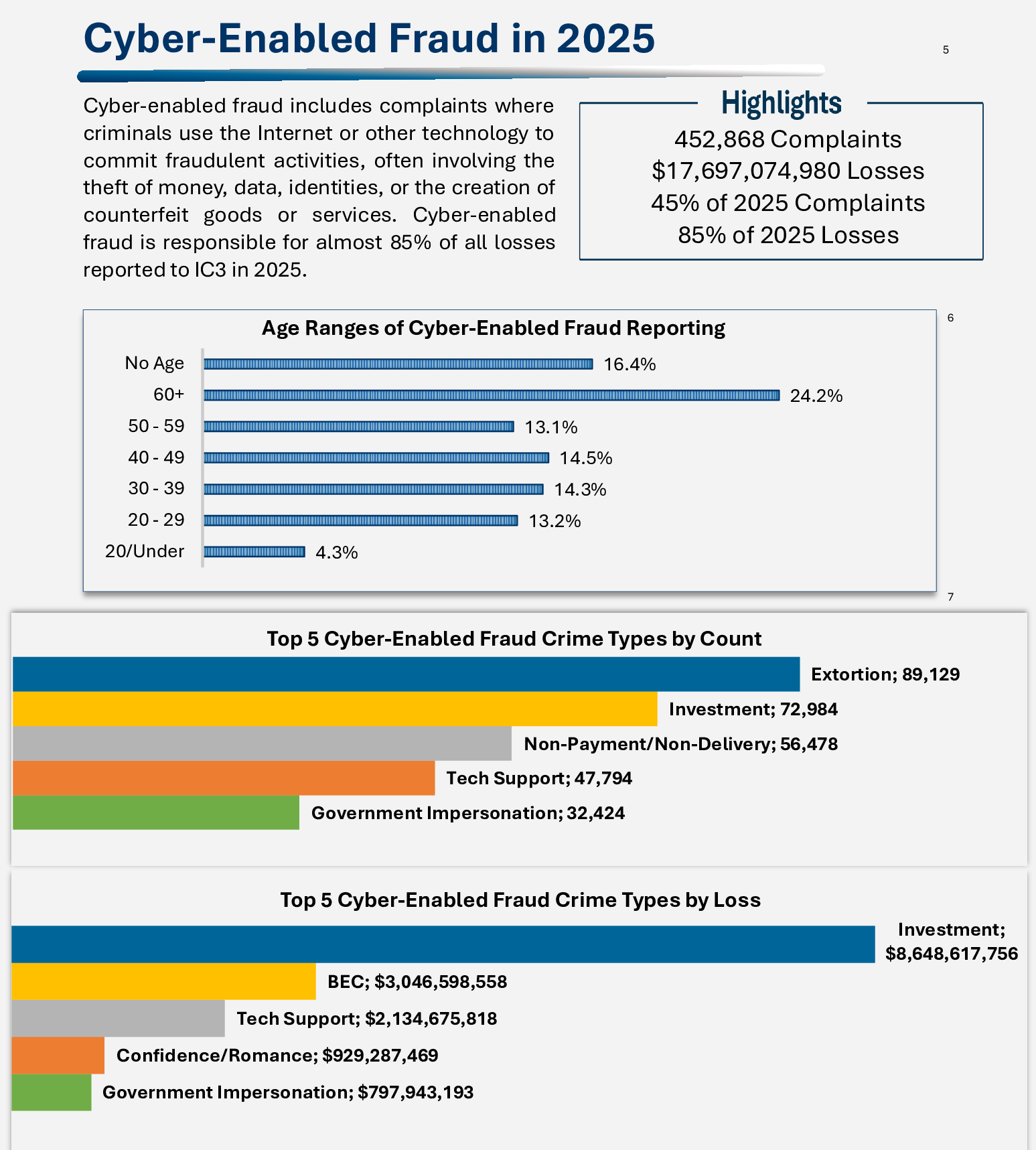
Internet fraud caused $17.7 billion in reported losses, accounting for 85% of all losses from IC3 complaints in 2025. In this section, people over 60 suffered the most from scammers, while extortion became the most common type of fraud by number of complaints.
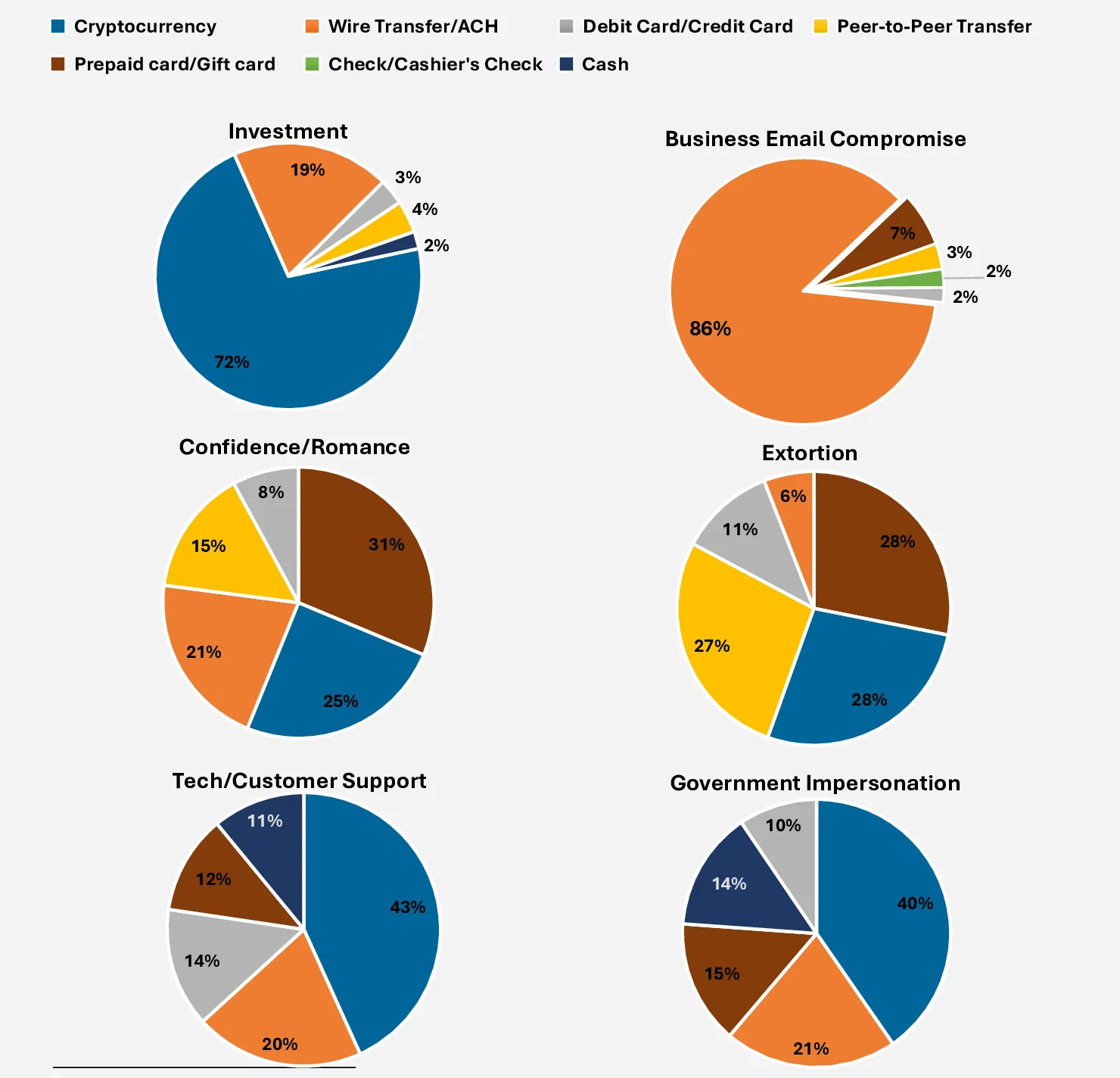
Scammers choose the payment method depending on the scheme: cryptocurrency is most often used for investments, bank transfers for business email compromise, and gift cards and personal transfers for blackmail and romance scams.
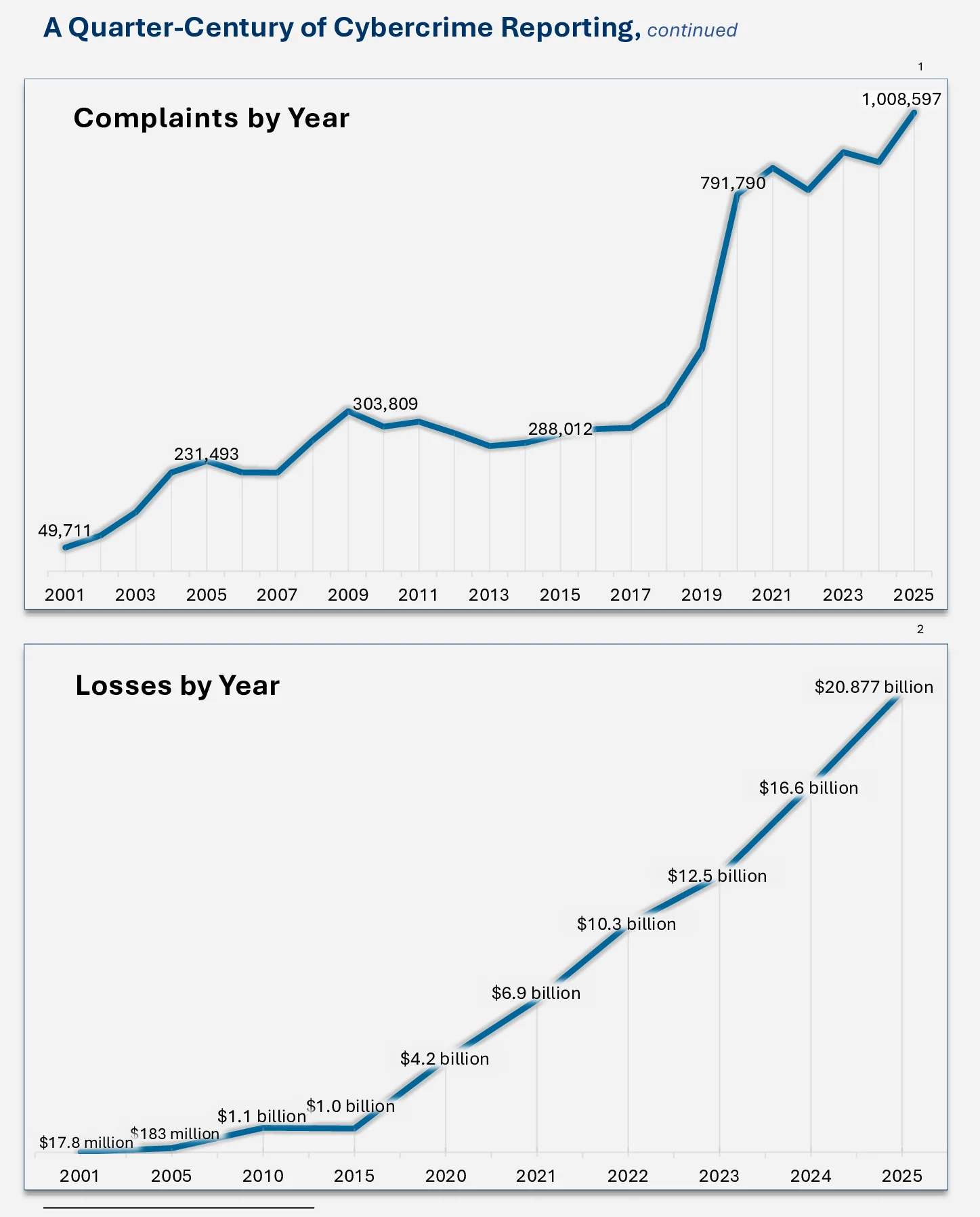
A quarter century of cybercrime reporting
Over 25 years, the number of complaints to IC3 has grown dozens of times and exceeded one million in 2025. While in 2001 people were losing millions, by 2025 the losses had reached almost $21 billion.
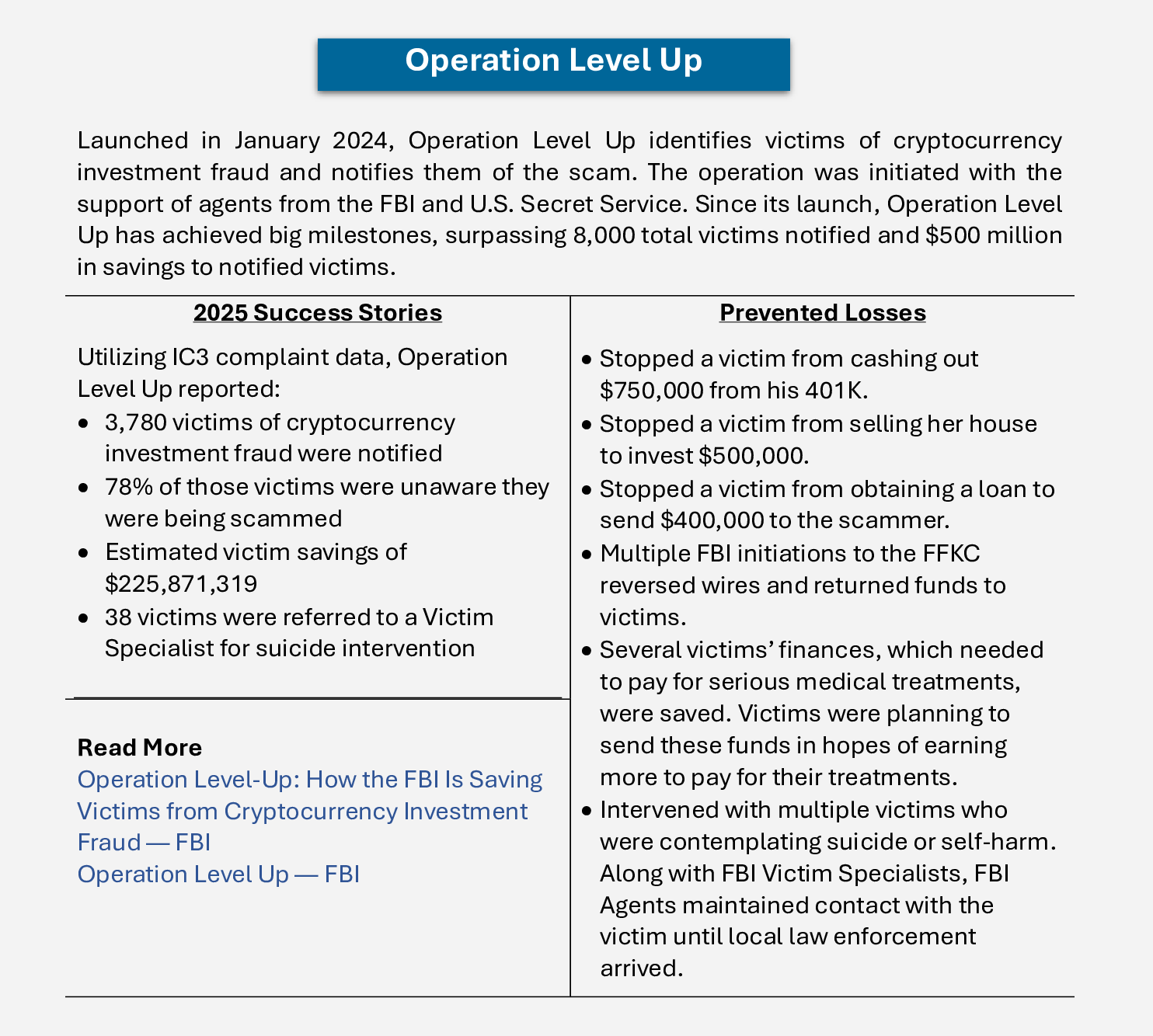
Special operations
Operation Level Up: 3,780 victims of cryptocurrency scams were warned (78% did not even know they were being scammed), and around $225 million was saved.
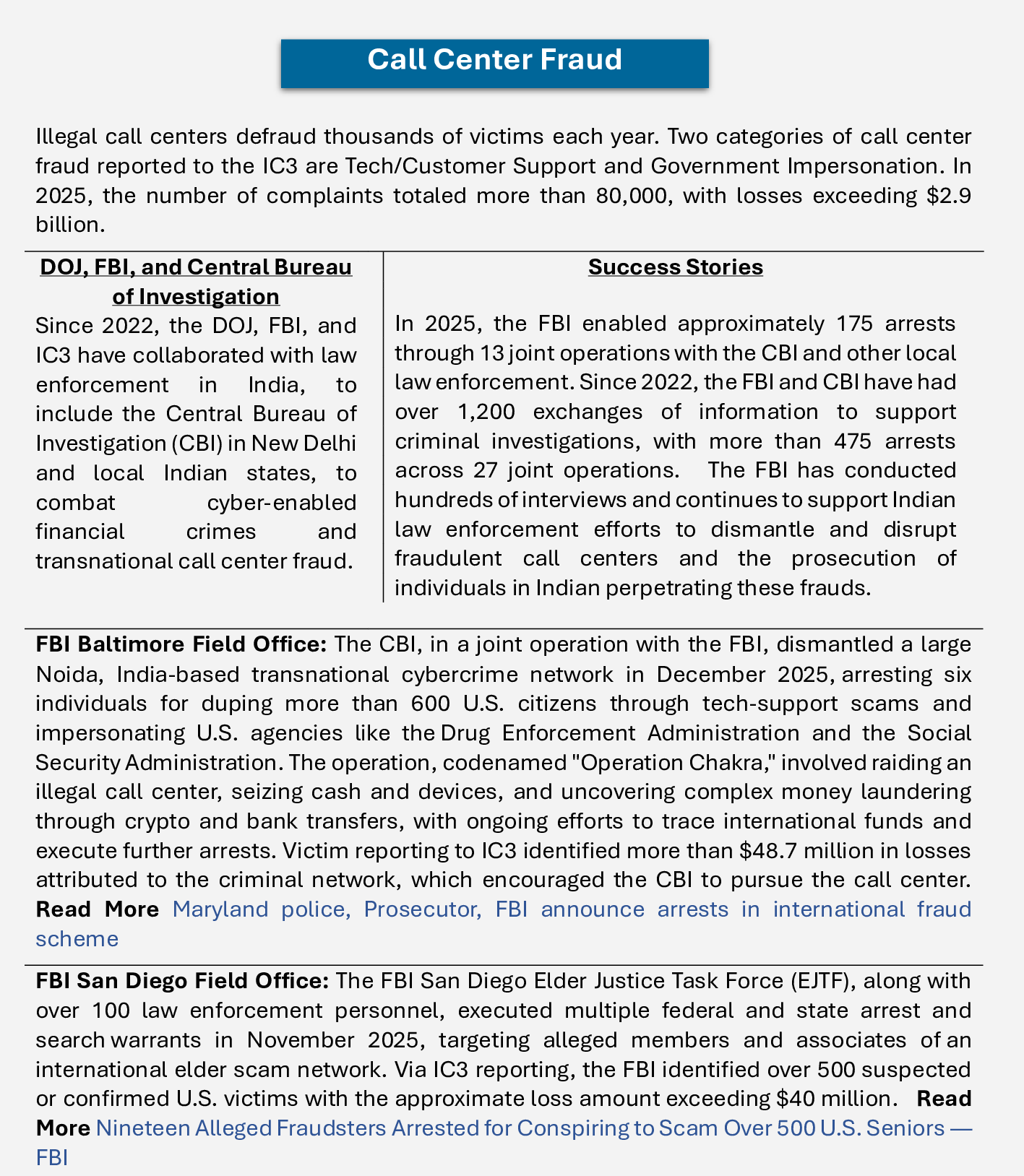
Call-center fraud. In 2025, the FBI assisted in approximately 175 arrests during 13 joint operations with the CBI and other agencies. Since 2022, the agencies have exchanged information more than 1,200 times, leading to 475 arrests as part of 27 operations.
- Operation in Baltimore: $48.7 million in losses, more than 600 people defrauded, 14 defendants arrested;
- Operation in San Diego: $40 million in losses, more than 500 incidents recorded, 10 key members of an international network arrested.
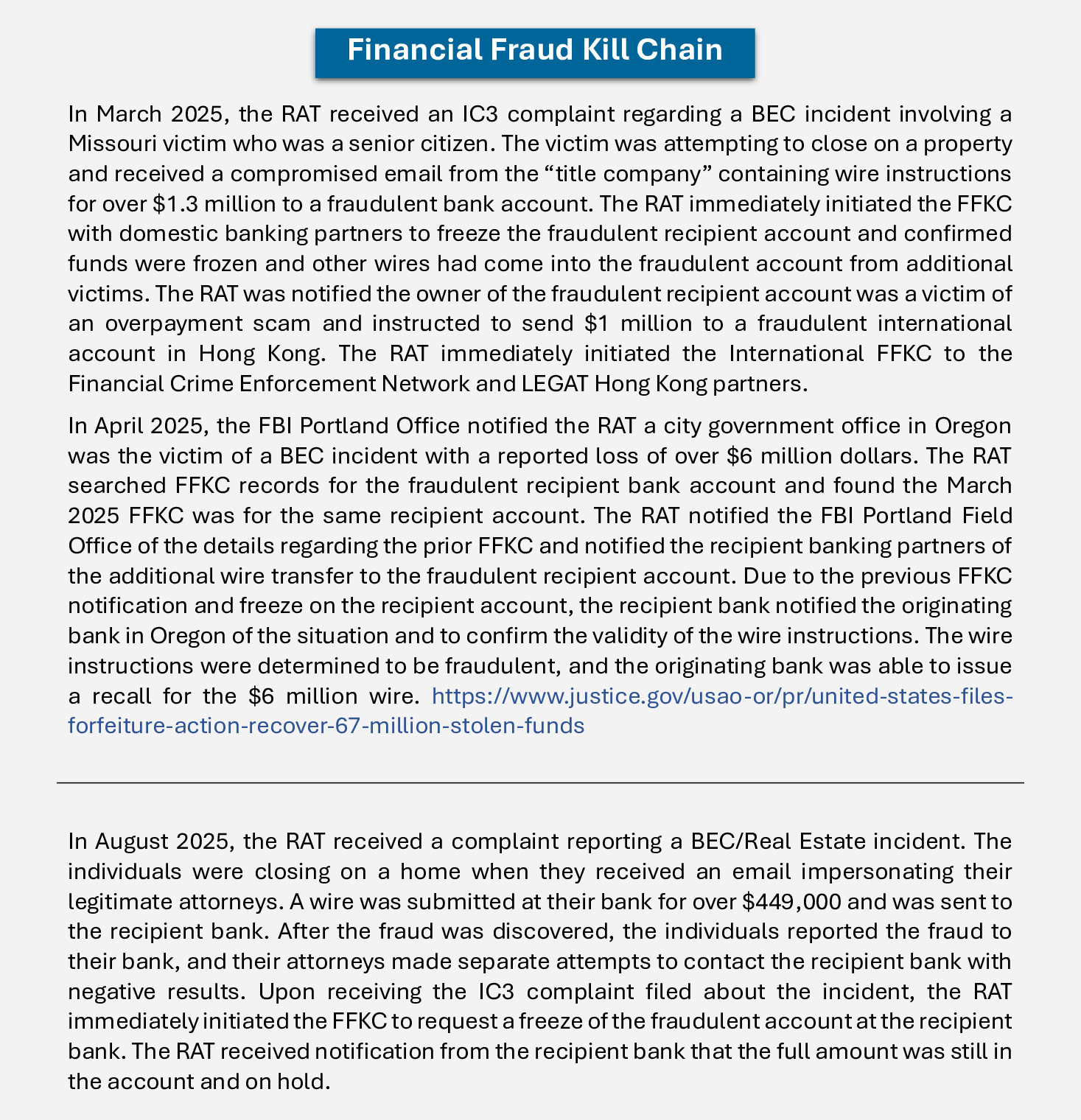
Financial Fraud Kill Chain:
- The FBI was able to prevent the theft of $6 million because it had previously frozen a fraudulent account after $1.3 million was stolen from a Missouri resident.
- The FBI’s Recovery Asset Team (RAT) managed to recover $449,000 that victims had transferred to scammers while buying a home.
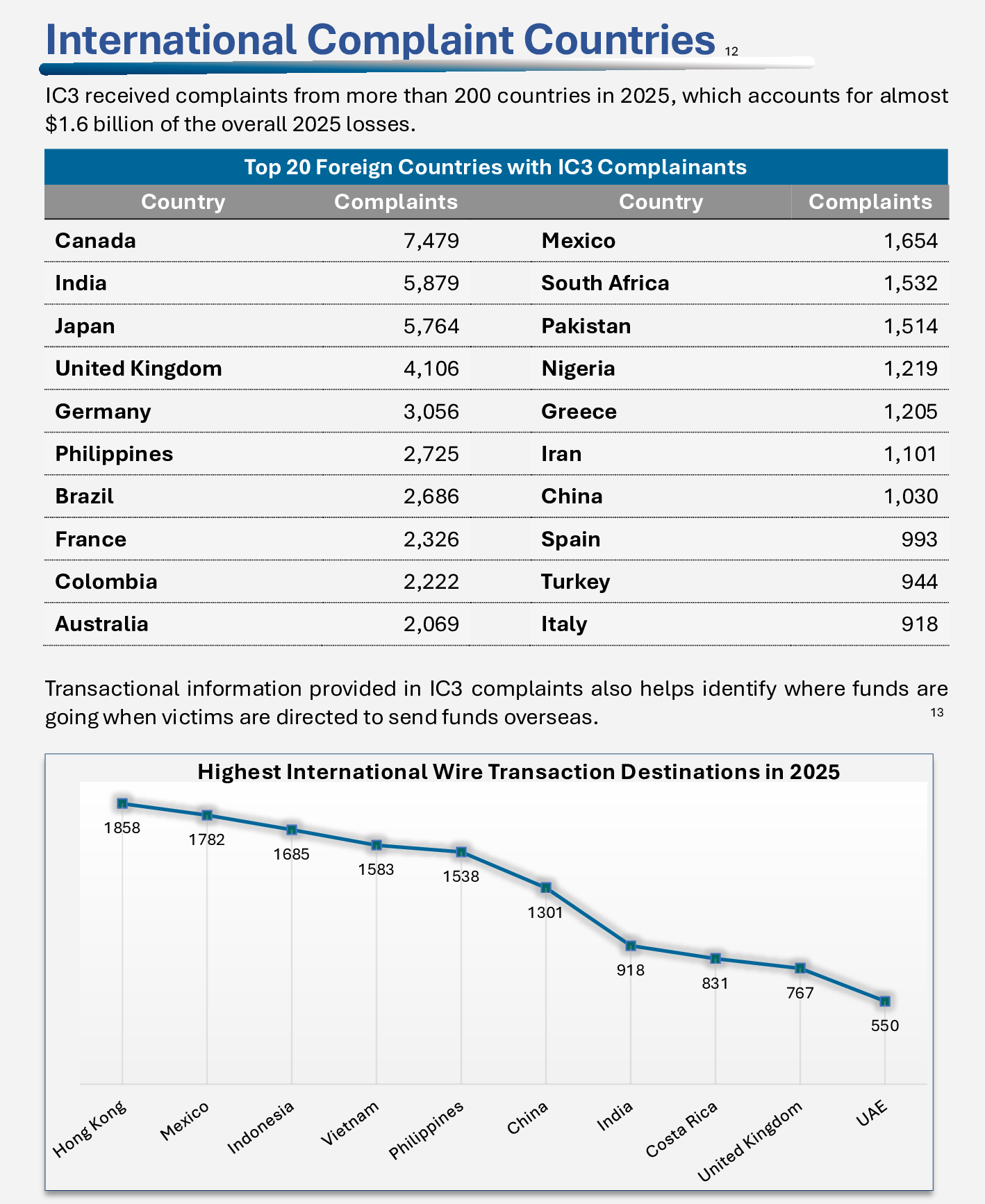
International geography of complaints
Complaints came from more than 200 countries, while losses from international complaints totaled almost $1.6 billion. Canada, India and Japan were the leading countries by number of complaints. In the United Kingdom, the number of complaints decreased 25-fold compared with 2024. Stolen transfers most often went to Hong Kong, Mexico and Indonesia.
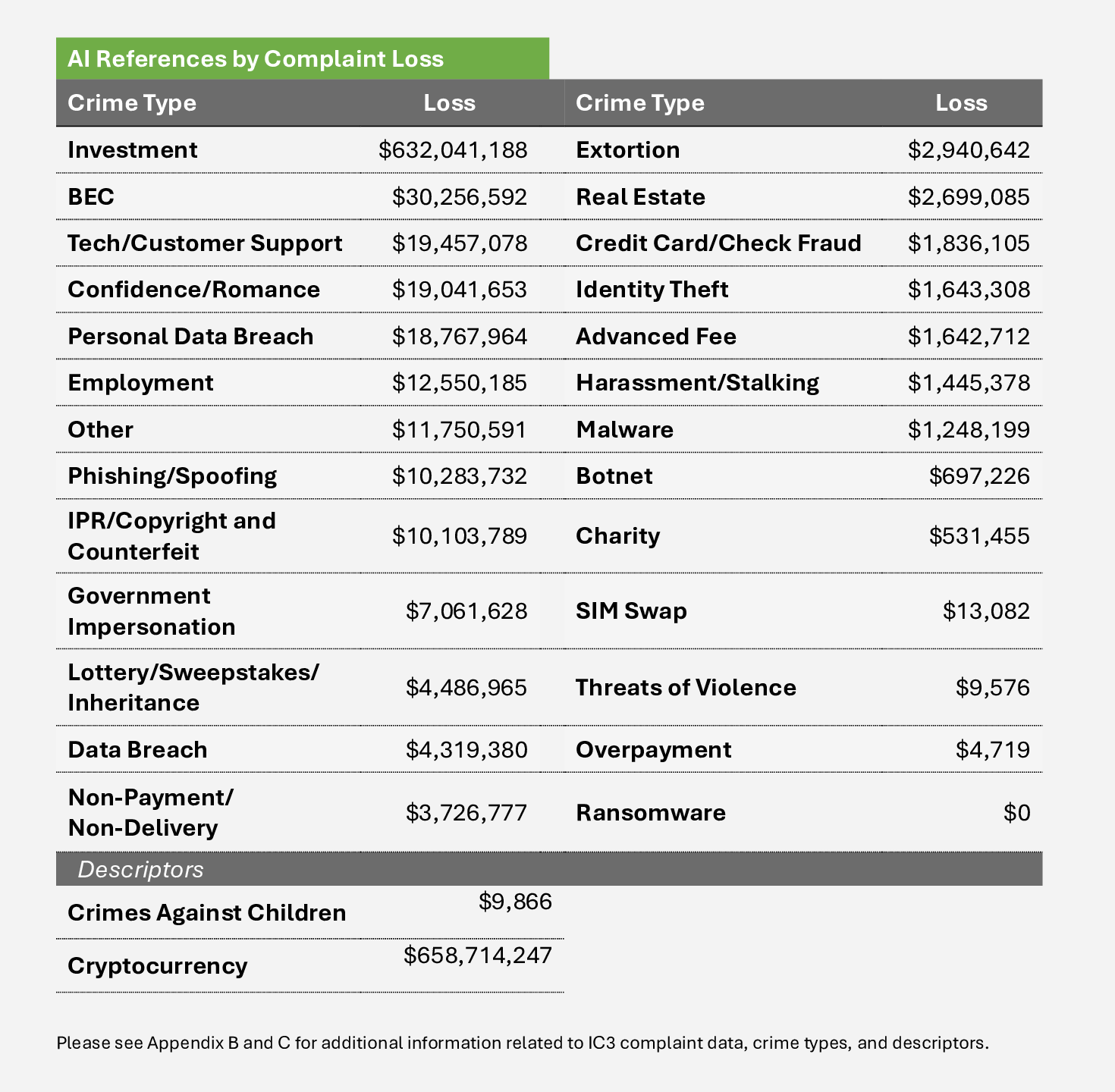
AI in internet fraud
More than 22,000 complaints were recorded, with total losses exceeding $893 million.
The main AI-powered fraud schemes:
- Investments ($632 million in losses): Scammers create thousands of convincing conversations and fake videos featuring the “faces” of celebrities or experts to steal money.
- Business email compromise (BEC) ($30 million in losses): AI writes emails on behalf of executives that sound highly professional, or clones a boss’s voice to request an urgent money transfer.
- Romance scams ($19 million in losses): AI helps create ideal profiles and write messages that are easier to fall for and believe.
- Employment scams ($13 million in losses): During video interviews, scammers use deepfakes (voice and face) to gain access to company networks while posing as a candidate.
- “Help a loved one” scams ($5 million in losses): Cloning the voice of a child or relative who is supposedly in trouble and needs money.
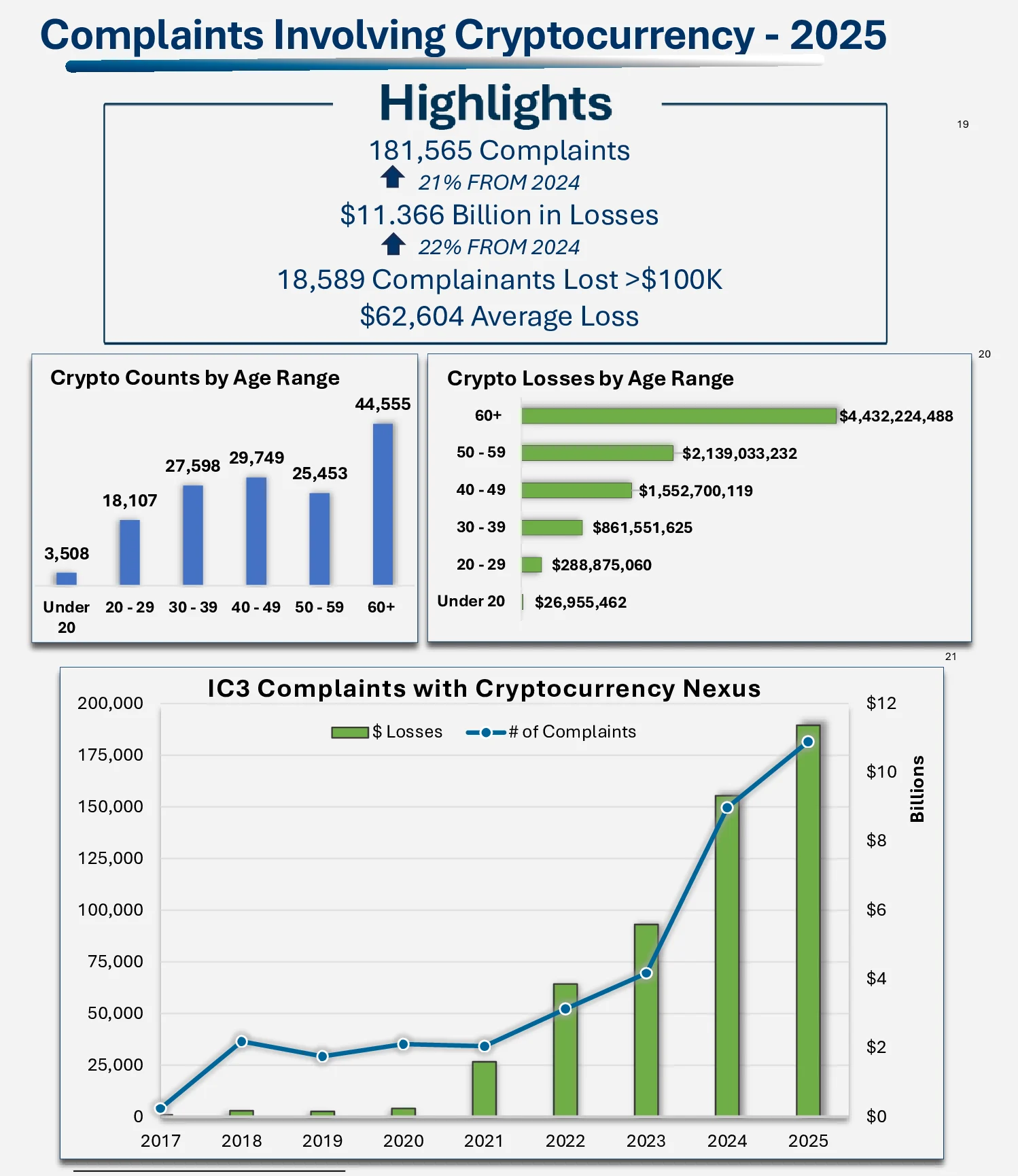
Cryptocurrency in internet fraud
In 2025, crypto scammers defrauded 181,000 people, which is 21% more than the previous year. People had $11 billion stolen, which is 22% more than in 2024. On average, each victim lost $62,000.
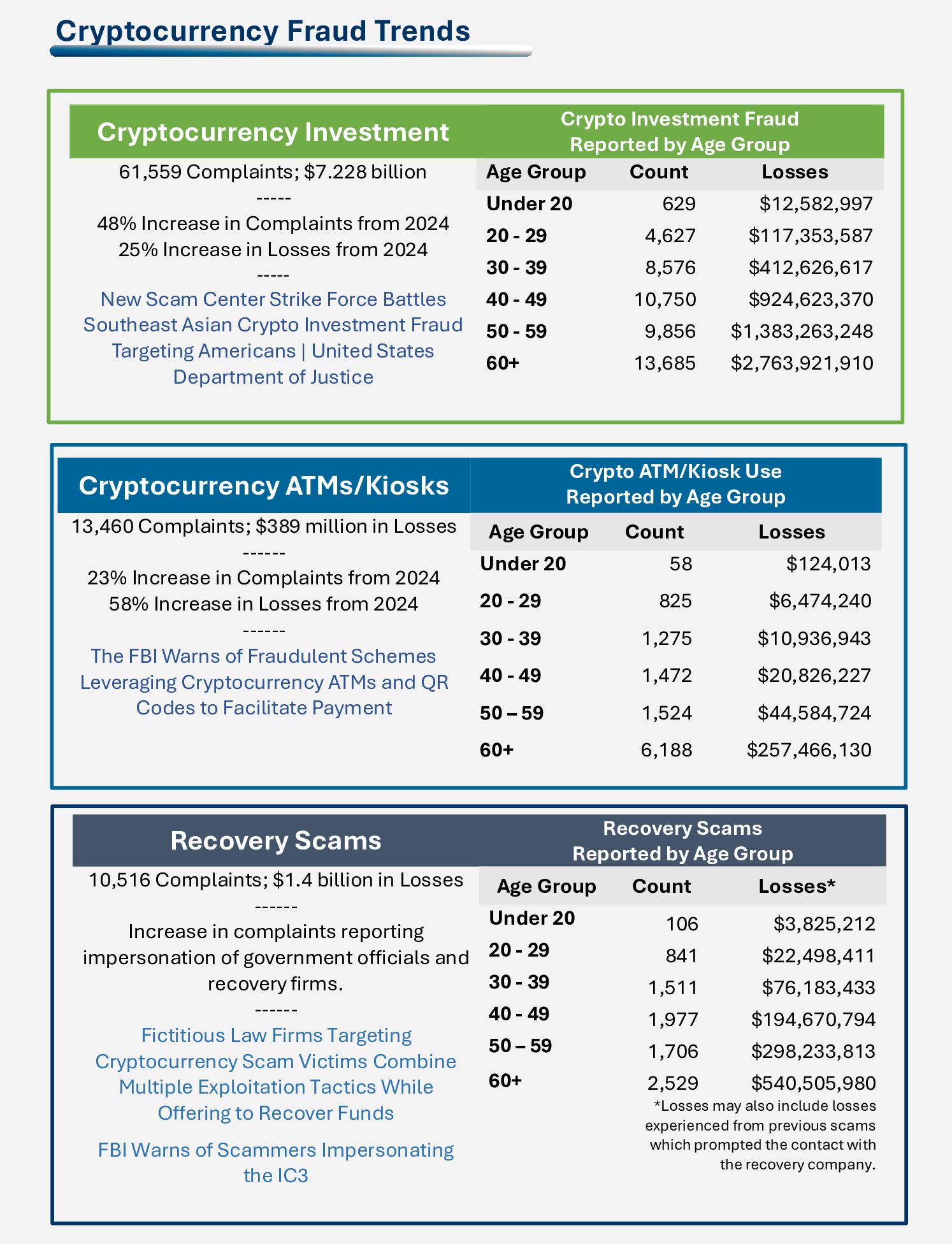
- Crypto investments were the most common scam. People lost $7.2 billion on “profitable investments.”
- Repeated scams targeting those who had already been defrauded, involving “help recovering stolen funds,” caused another $1.4 billion in losses.
- Data breaches — $939 million.
- Money transfers through crypto ATMs at scammers’ instructions — $389 million. A 58% increase compared with 2024.
Across all schemes, people over 60 suffer the most. Scammers often pretend to be employees of government agencies or law firms to gain trust.
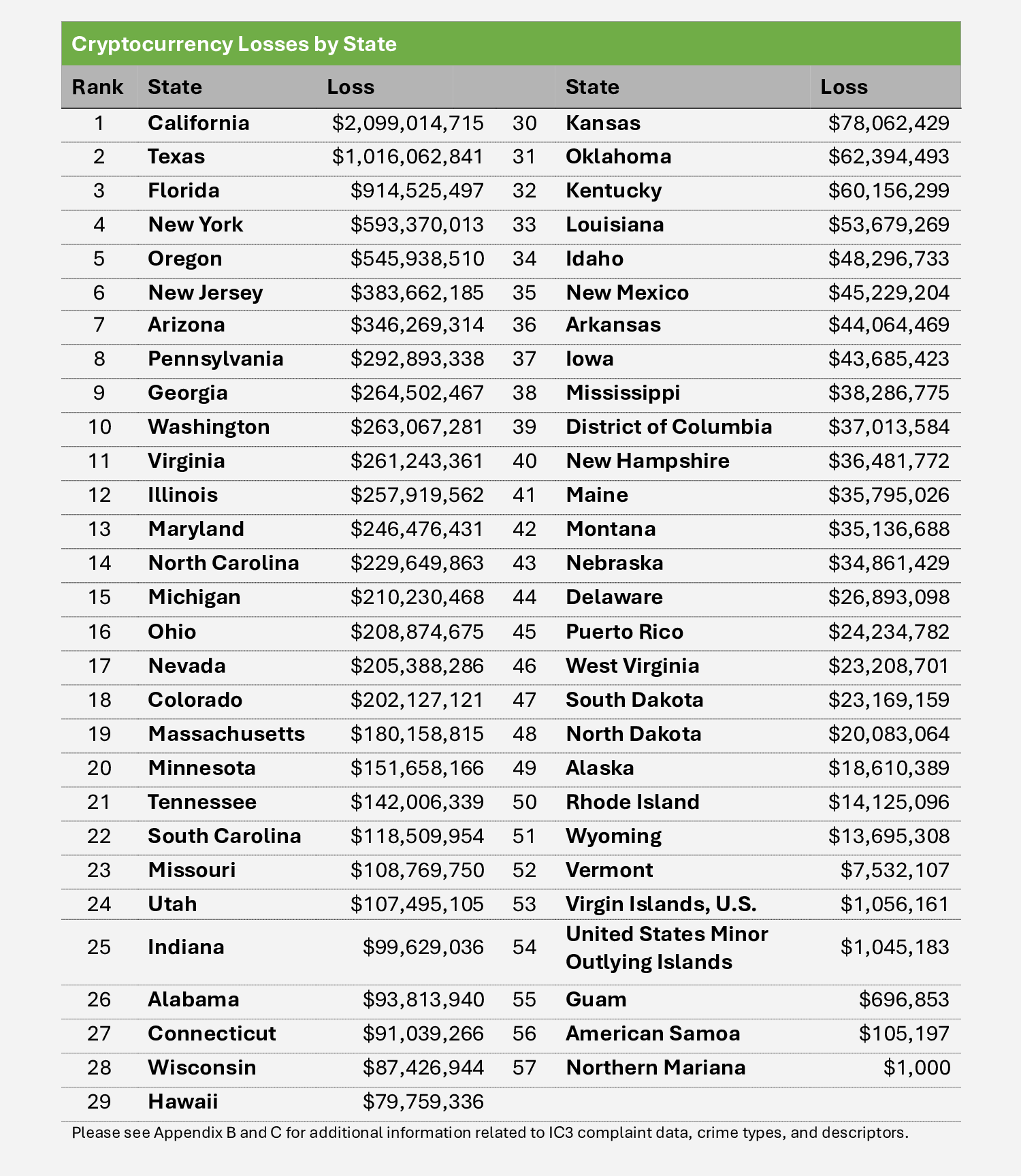
In 2025, the largest cryptocurrency losses were recorded in major states: more than $2 billion in California, more than $1 billion in Texas, and around $914 million in Florida. Small islands suffered the least: for example, losses in the Northern Mariana Islands totaled only $1,000, while the amounts in American Samoa and Guam were also very small.
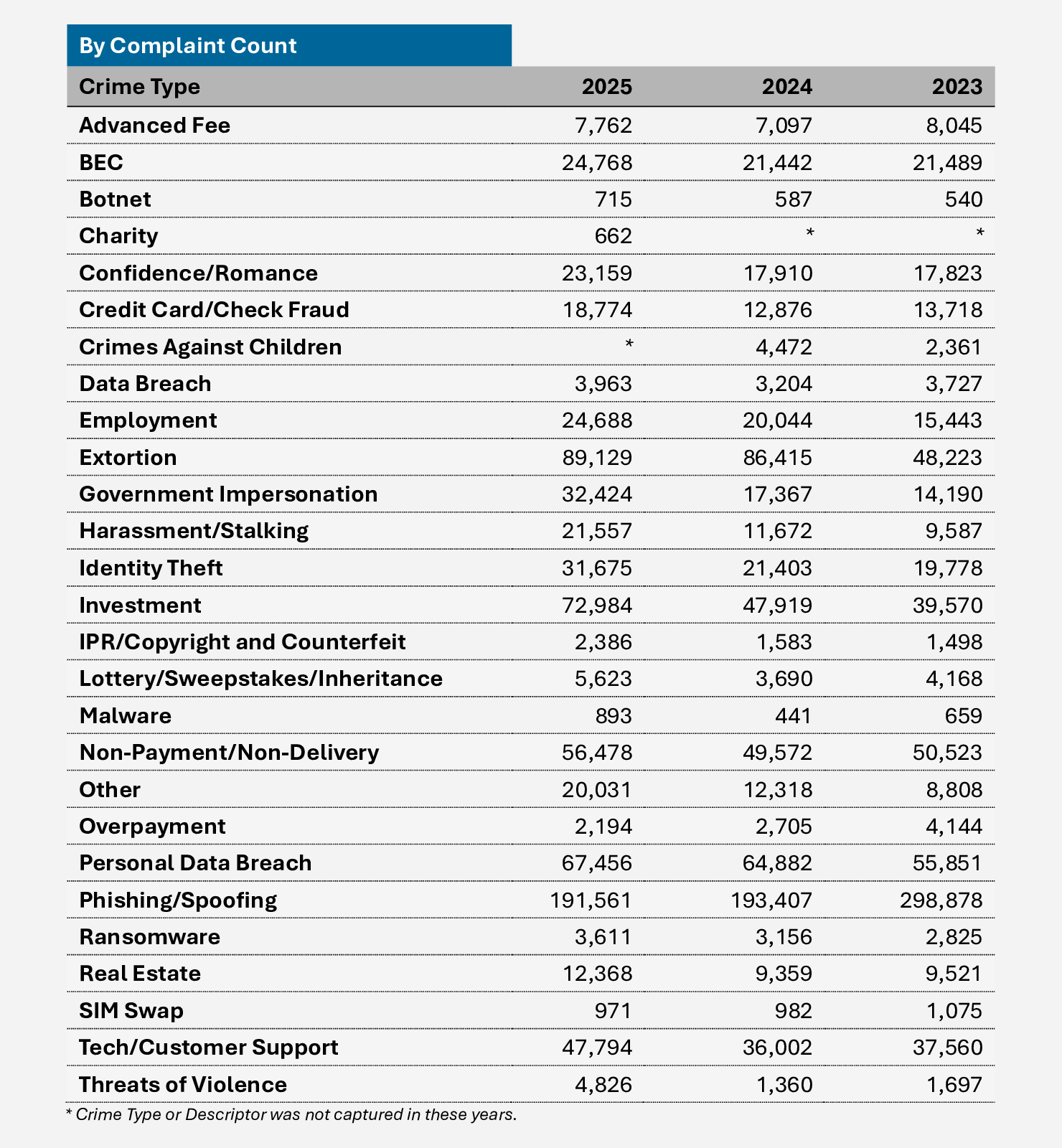
Trends in popular fraud schemes (2023–2025)
- The number of complaints about investment scams jumped from 48,000 to 73,000, extortion complaints rose from 86,000 to 89,000, and cases involving fake government employees almost doubled, from 17,000 to 32,000.
- The popularity of some old schemes declined slightly: mass phishing decreased from 193,000 to 191,000, while overpayment scams fell from 2,700 to 2,200.
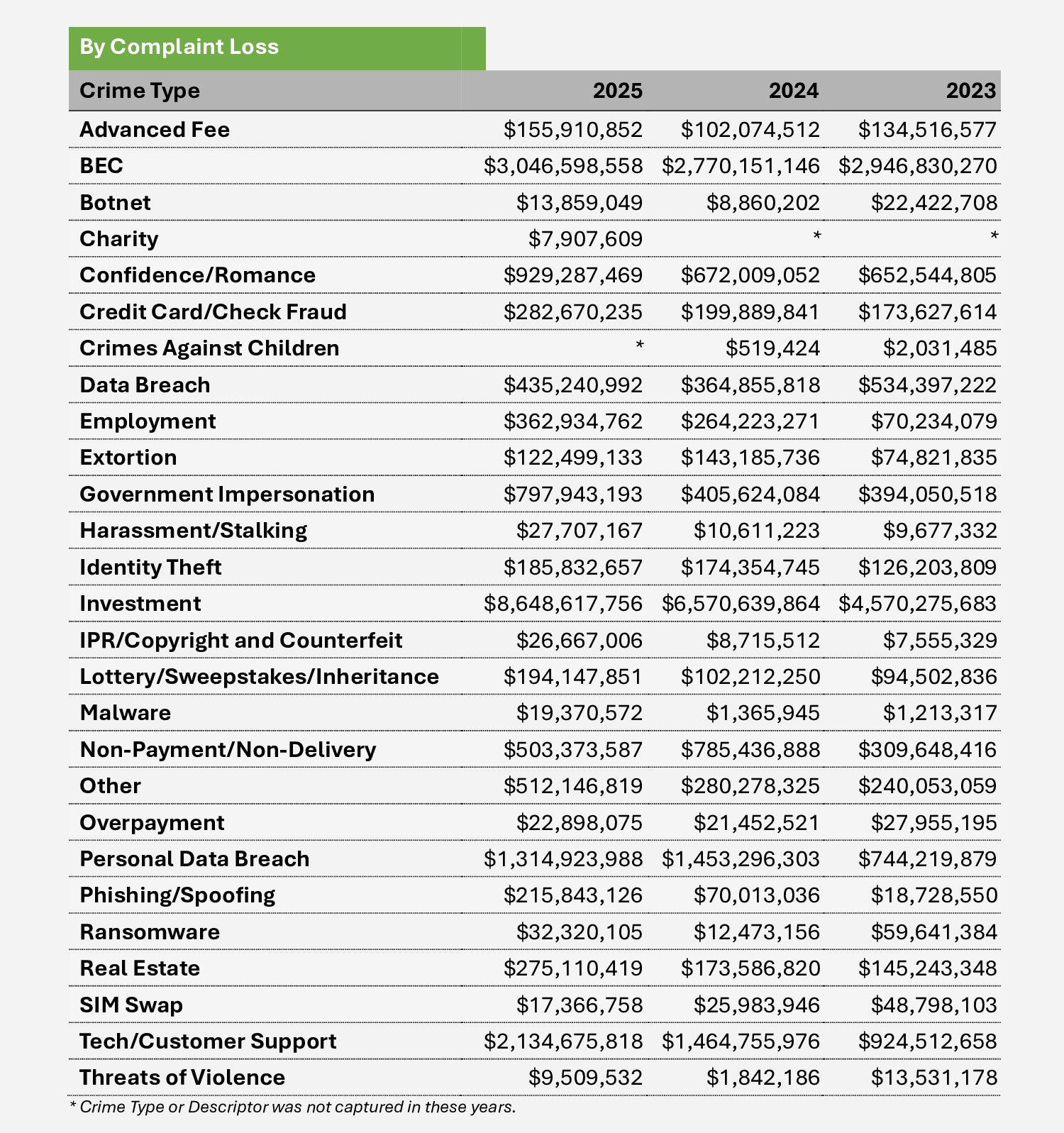
- Losses from investment scams surged from $6.6 billion to $8.6 billion in one year, losses from fake support services jumped from $1.5 billion to $2.1 billion, and losses from fake government agencies nearly doubled, from $406 million to $798 million.
- Losses from personal data breaches fell from $1.5 billion to $1.3 billion, losses from non-delivery/non-payment scams decreased from $785 million to $503 million, and losses from SIM card theft dropped from $26 million to $17 million.
Complaints and losses by U.S. state
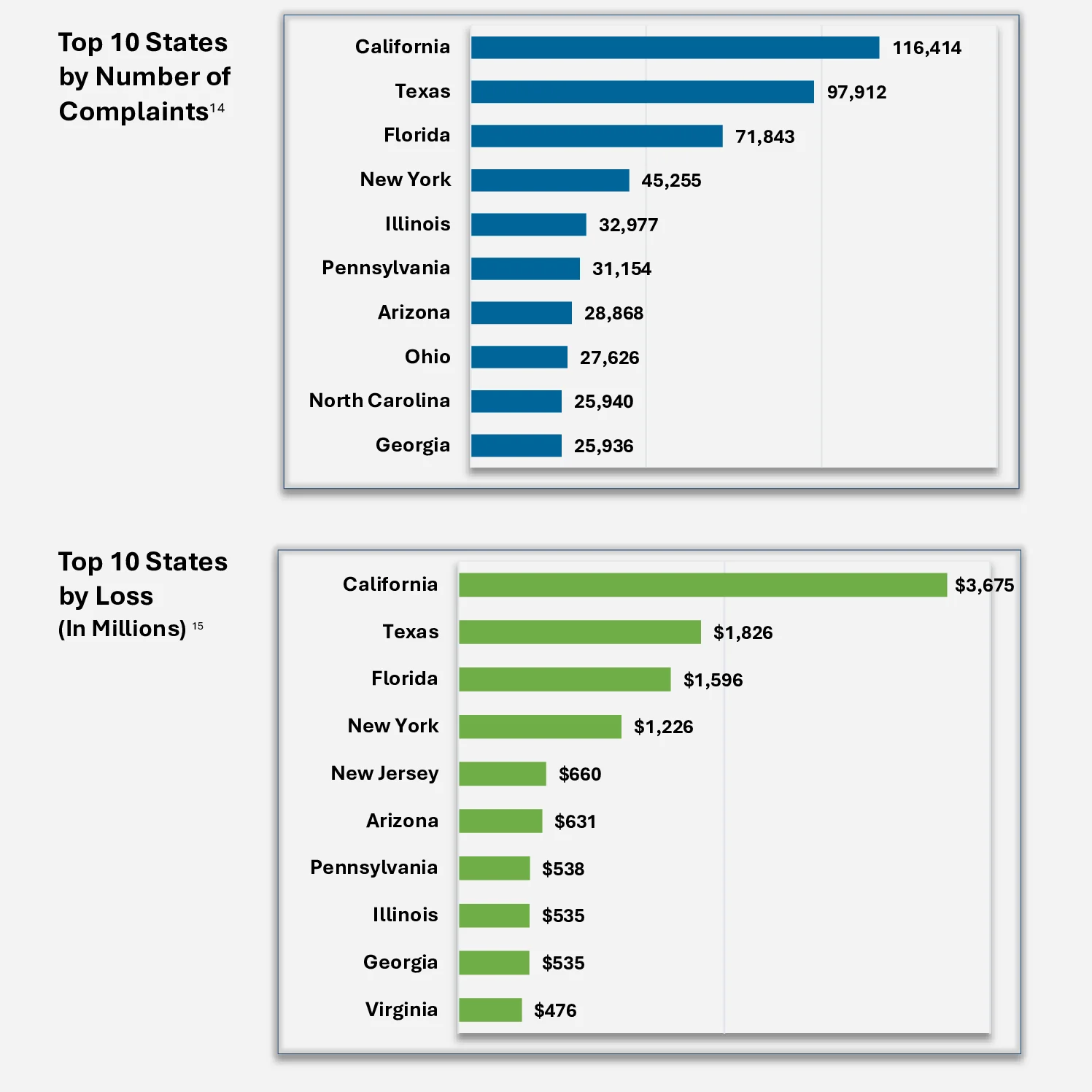
Top 10 states by number of complaints over three years:
- California — 116,414
- Texas — 97,912
- Florida — 71,843
- New York — 45,255
- Illinois — 32,977
- Pennsylvania — 31,154
- Arizona — 28,868
- Ohio — 27,626
- North Carolina — 25,940
- Georgia — 25,936
Top 10 states by total losses:
- California — $3,675 million
- Texas — $1,826 million
- Florida — $1,596 million
- New York — $1,226 million
- New Jersey — $660 million
- Arizona — $631 million
- Pennsylvania — $538 million
- Illinois — $535 million
- Georgia — $535 million
- Virginia — $476 million
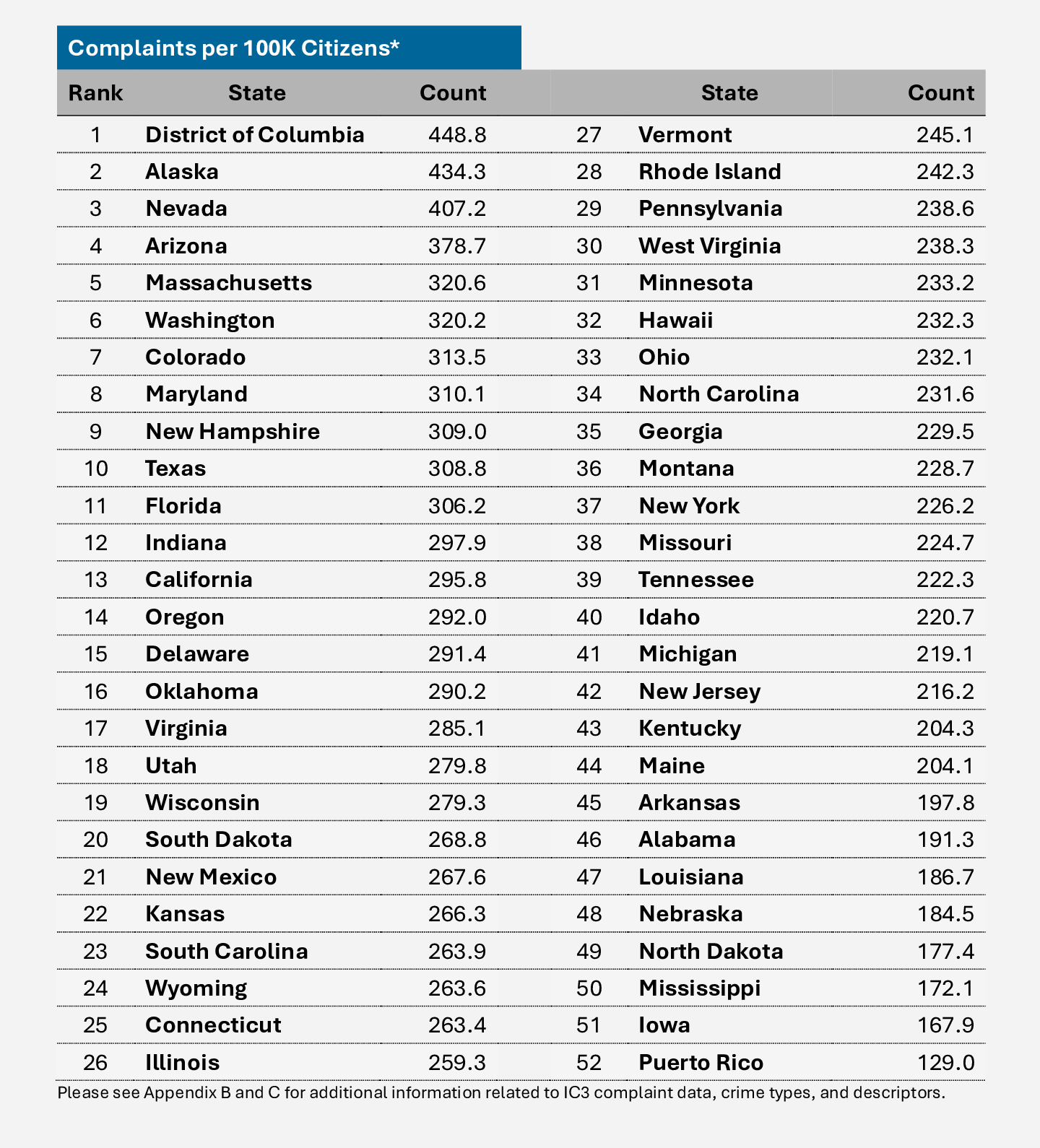
By complaints per 100,000 people in 2025, the leaders were the District of Columbia (448), Alaska (434) and Nevada (407), while Puerto Rico had the fewest (129). In Alaska, the number of complaints fell from 914 to 434 over the year, while in Puerto Rico it rose from 70 to 129.
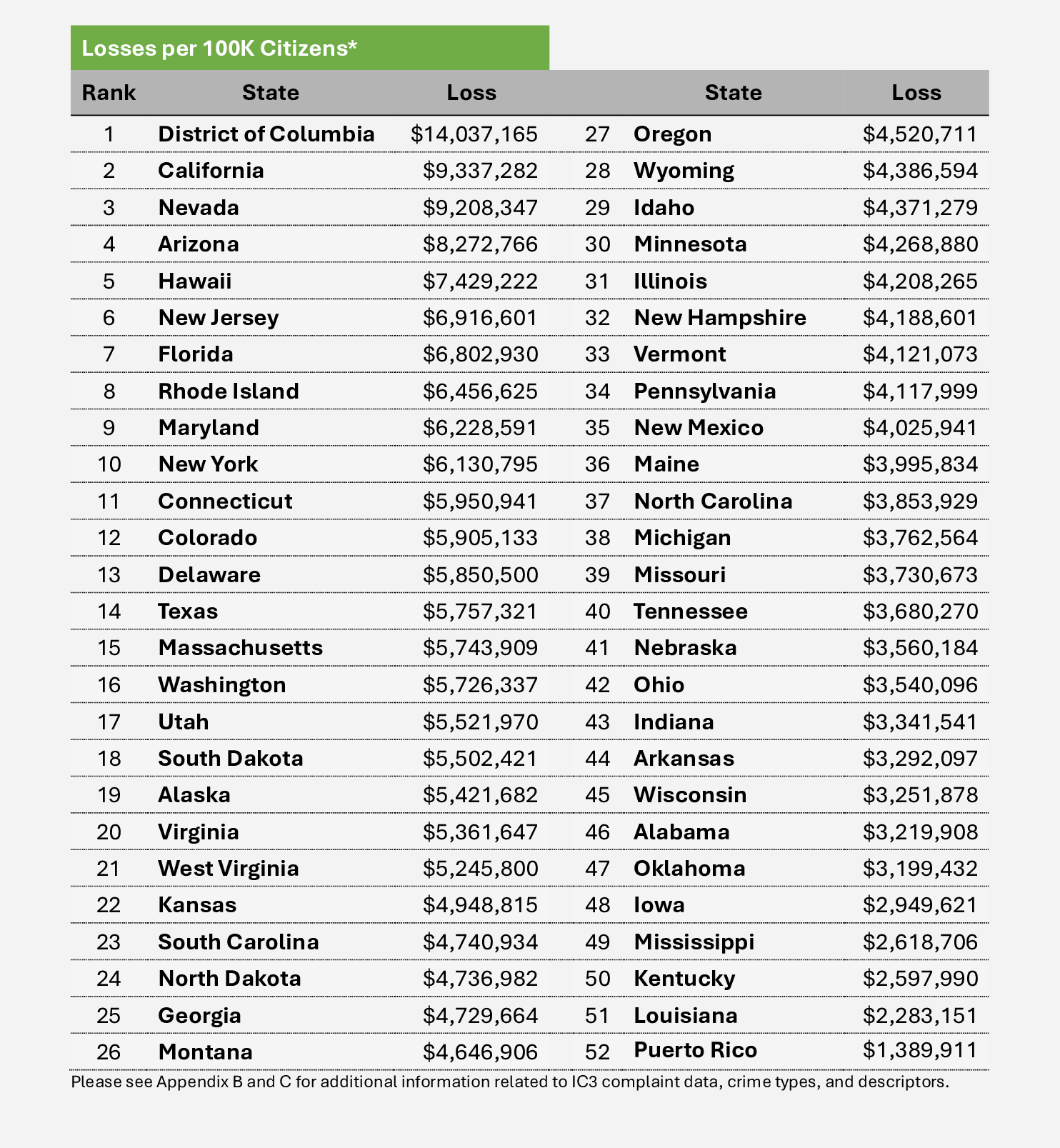
The District of Columbia led in losses per 100,000 people in 2025 ($14 million), while Puerto Rico had the lowest figure ($1.4 million). Per capita losses in the District of Columbia fell from $41.5 million in 2024 to $14 million in 2025, while the figure in Nevada rose from $8.2 million to $9.2 million, and in California from $6.4 million to $9.3 million.
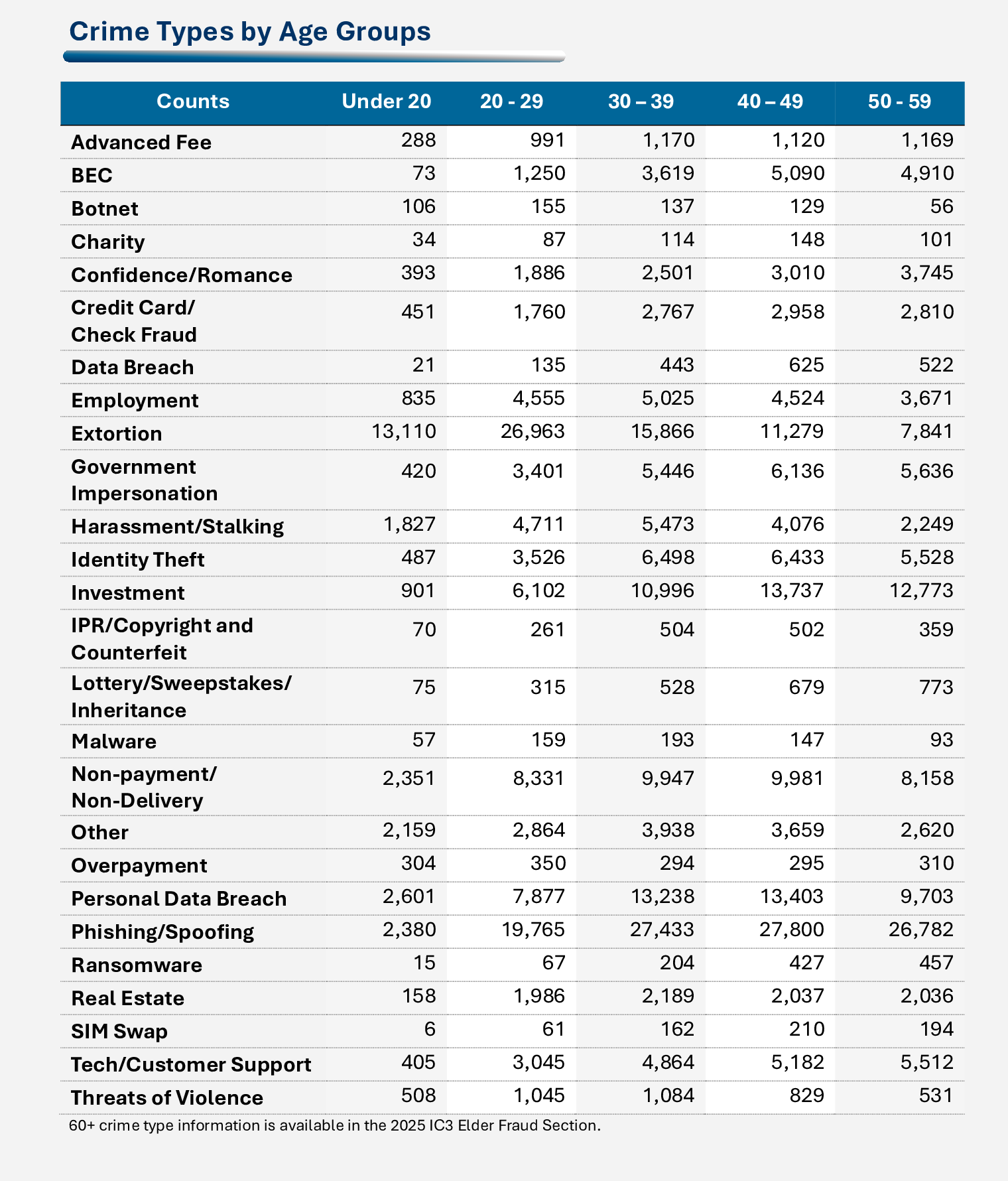
Fraud schemes by age group
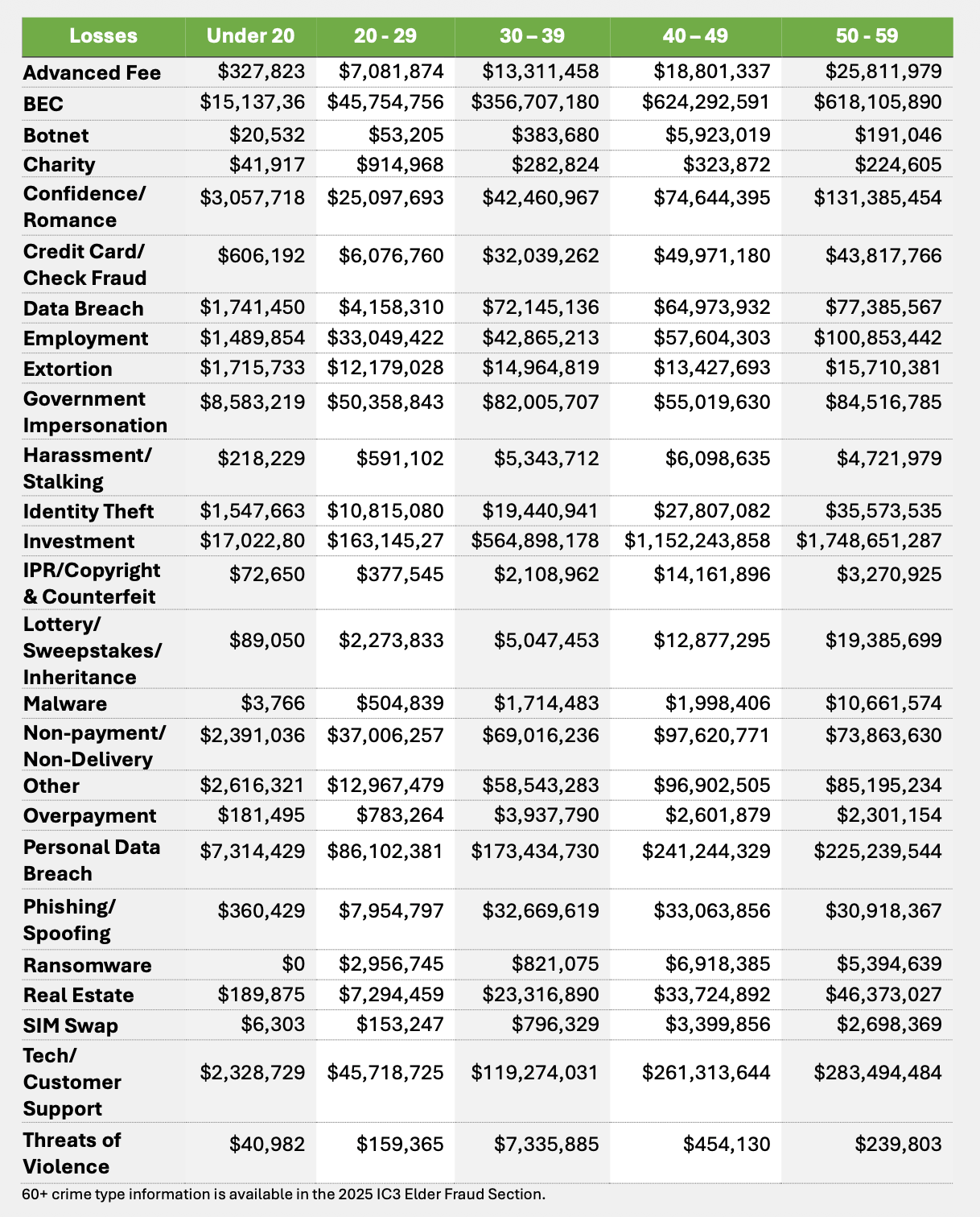
- Under 20: extortion leads (13,100), followed by personal data breaches (2,600) and non-payment/non-delivery (2,300).
- 20–29: most often targeted by extortion (26,900) and phishing (19,700), and actively fall for fake job offers (4,500).
- 30–39: widely affected by phishing (27,400) and investments (10,900), with many complaints about data breaches (13,200).
- 40–49: the leaders are phishing (27,800) and investments (13,700), with many complaints about data breaches as well (13,400).
- 50–59: phishing again (26,700) and investments (12,700), along with a significant number of identity theft cases (5,500) and BEC scams (4,900).
By total losses among groups under 60, investment schemes were the most expensive category: losses from them grow with age and reach their peak among people aged 50–59, where they amounted to $1.75 billion. For groups from 20 to 59, the second-largest loss category was business email compromise (BEC).
Seniors (60+): complaints, losses, geography
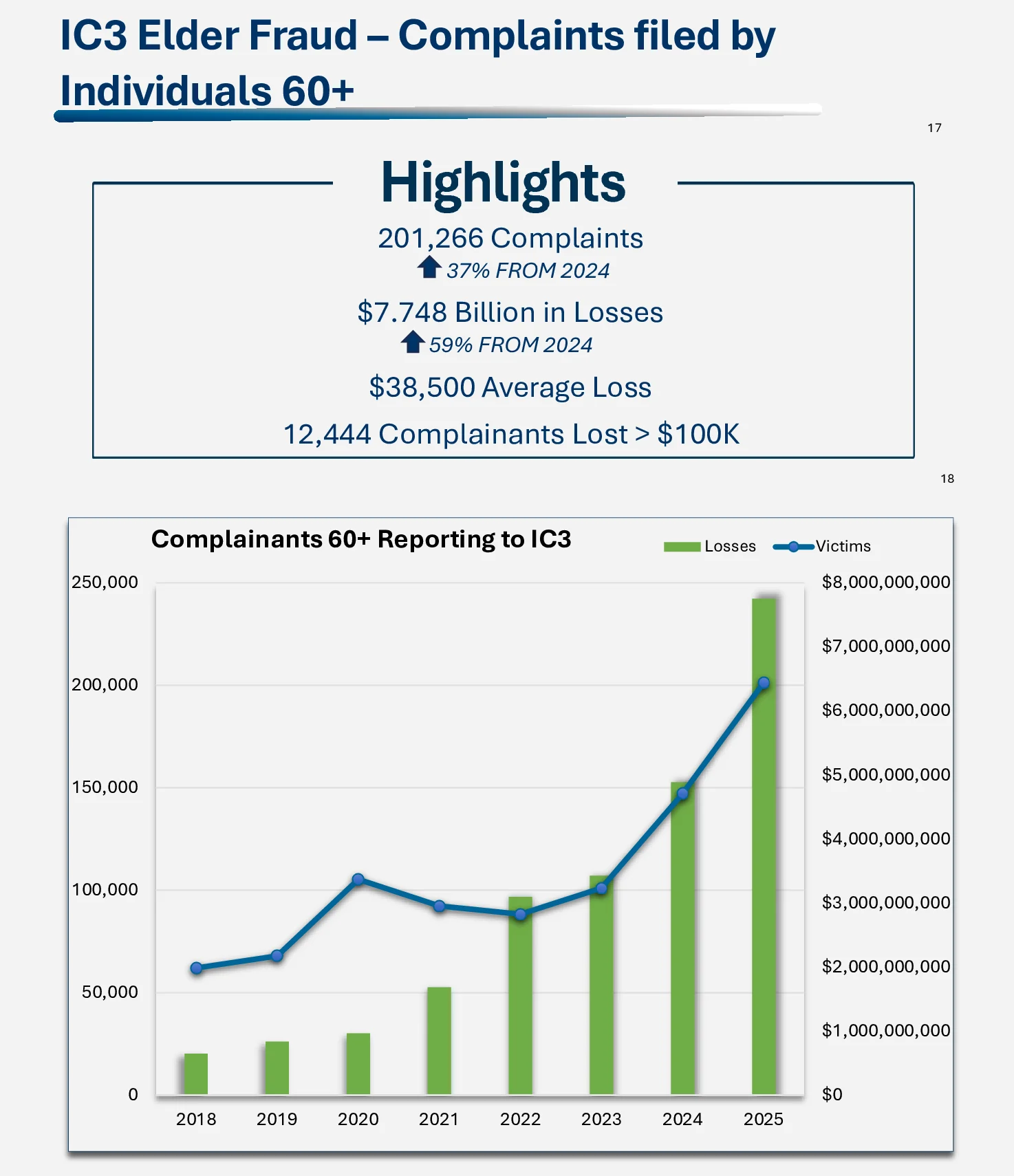
People aged 60+ filed 201,000 complaints in 2025 and lost $7.75 billion, which is 37% more complaints and 59% more money than in 2024. For 12,444 seniors, losses exceeded $100,000, with the average loss at $38,500.
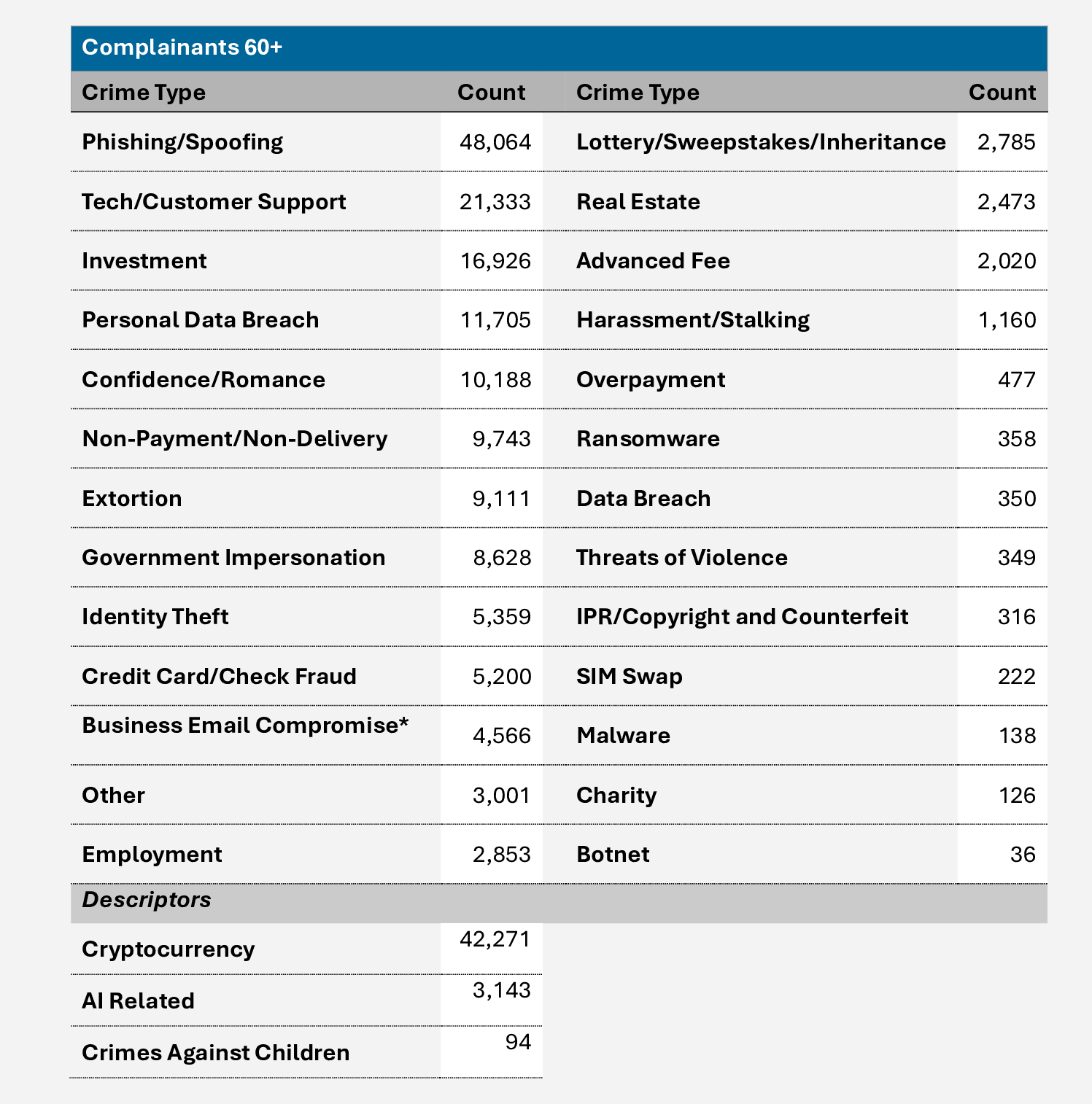
The largest number of complaints involved phishing (48,000), fake tech support scams (21,300) and investment scams (16,900).
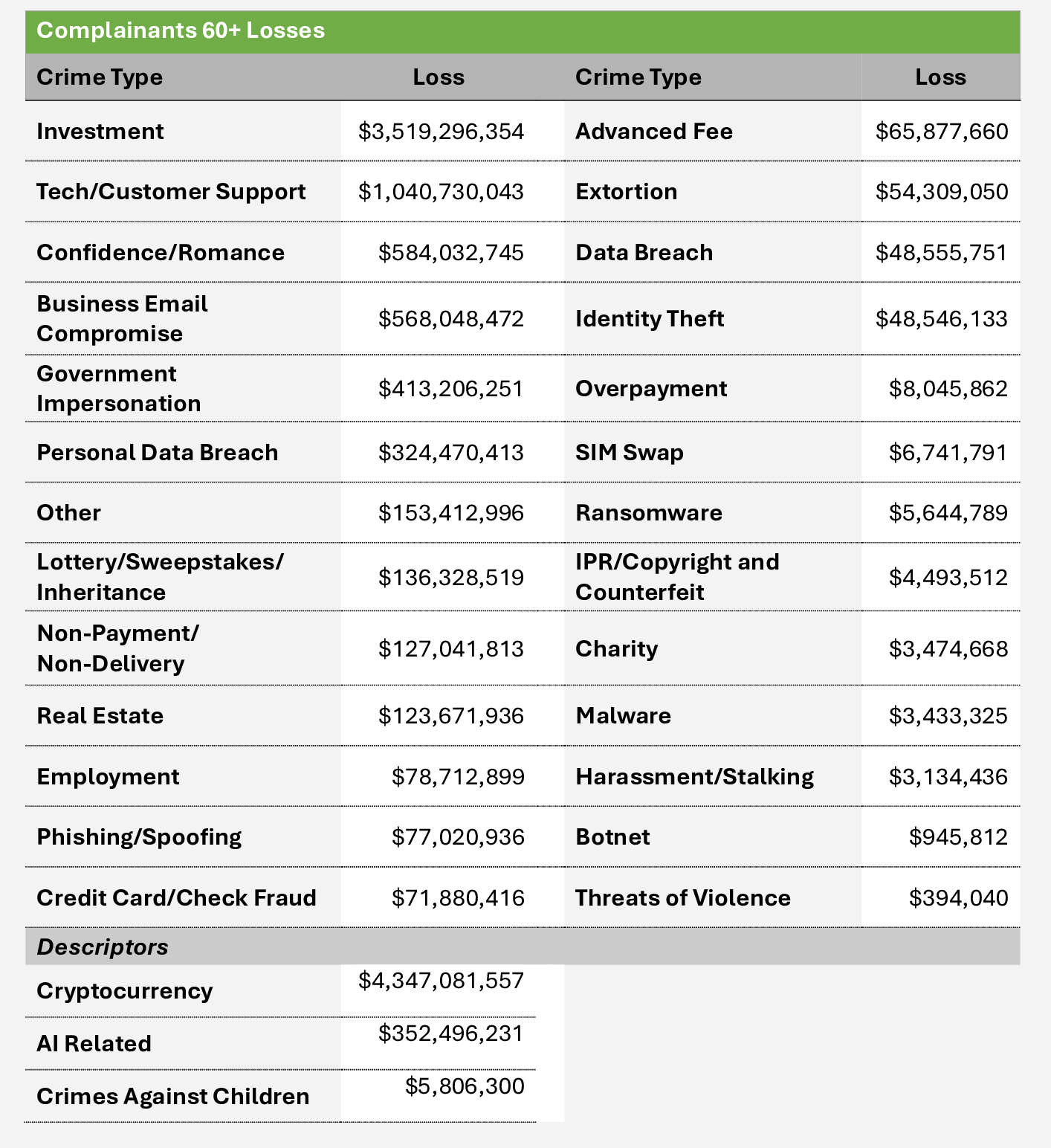
The main losses in 2025 came from investment scams at $3.5 billion, fake tech support at $1 billion, romance scams at $584 million, and business email compromise schemes at $568 million.
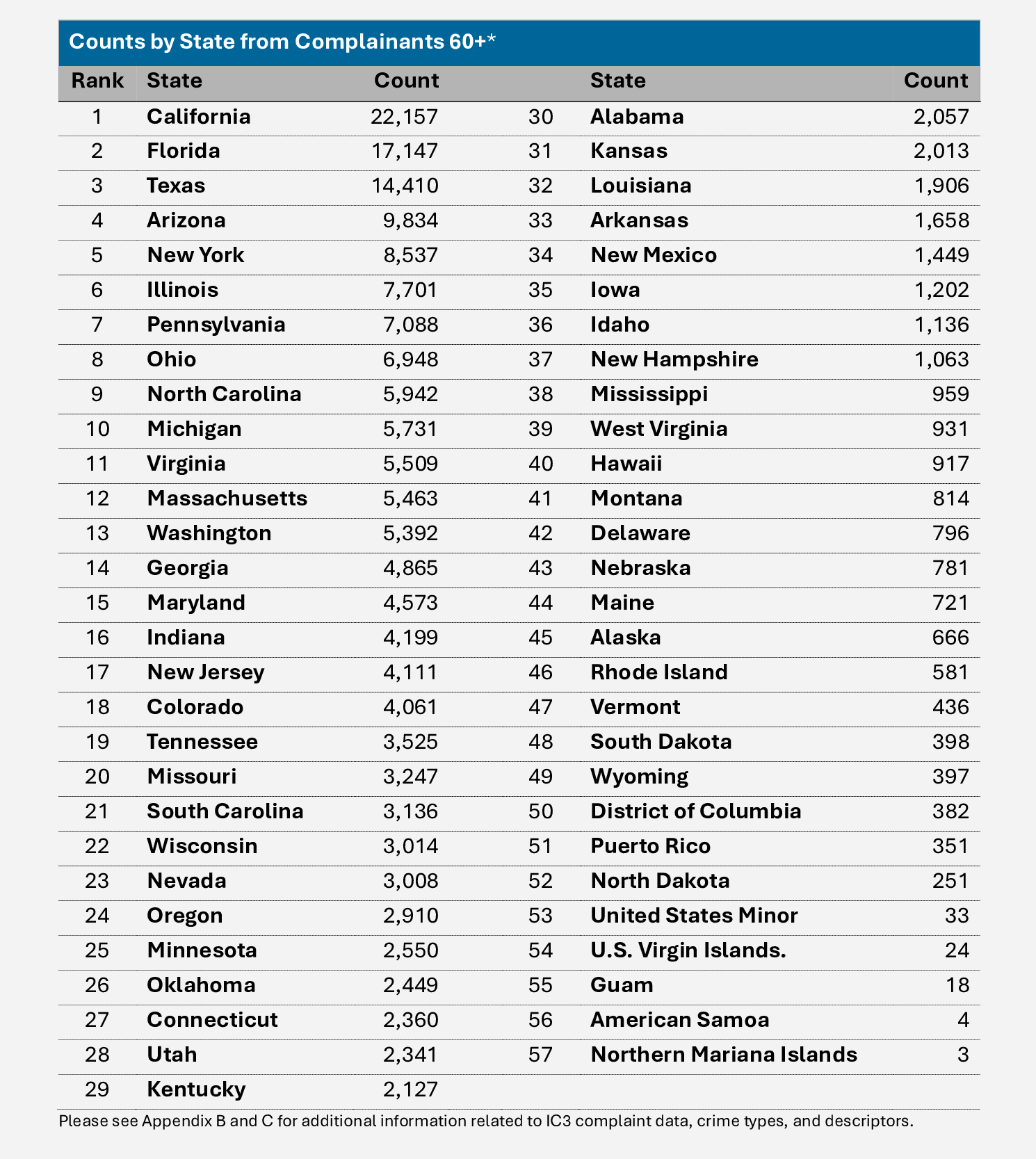
The leaders by number of complaints were California with 22,157, Florida with 17,147 and Texas with 14,410, while the fewest complaints came from territories such as American Samoa with 4 and the Northern Mariana Islands with 3.
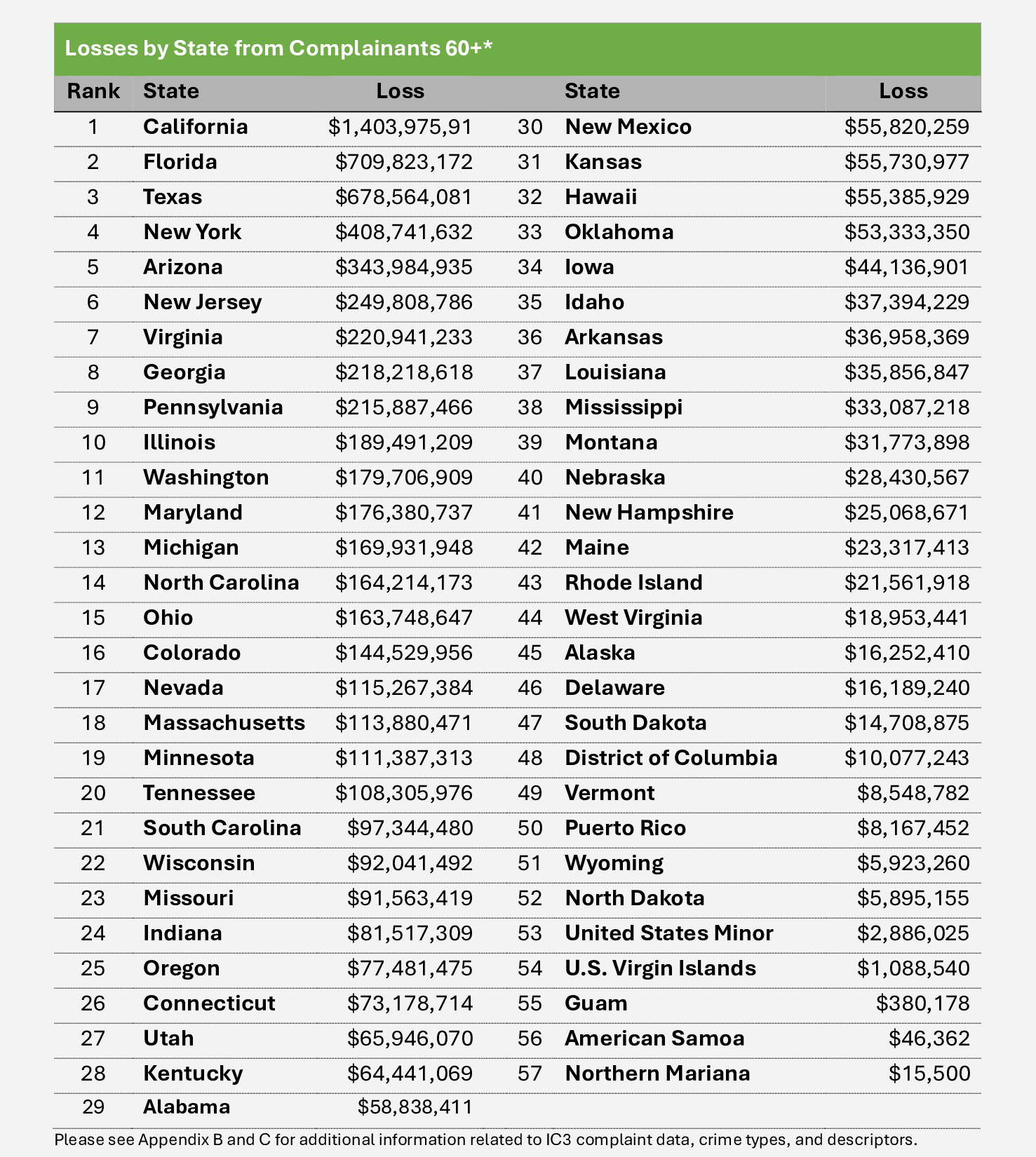
The largest losses were recorded in California at $1.4 billion, Florida at $709 million and Texas at $678 million. The lowest losses were recorded in American Samoa at $46,000 and the Northern Mariana Islands at $15,000.








Comments