






We tested the free self-hosted trackers YellowTDS, Simple Kuma, AdLex, and Prosper202 under increasing load. The source code for each tracker is available on GitHub. We also compared the results with previous tests of Binom v2 and Keitaro.
Popular CPA trackers for affiliate marketing: https://cpa.rip/services/cpa-trackers/.
Test Setup and Methodology
Each tracker was tested separately on a VPS with 4 vCPU and 4 GB of RAM running Ubuntu 24.04. The k6 click generator ran on a second VPS.
We ran load tests in two modes: with unique and repeated clicks. The load steps were 20 -> 40 -> 80 -> 160 -> 320 -> 480 requests/sec. Each test started at 20 requests/sec, then increased to the next step over 30 seconds and held it for three minutes. Requests were sent to a technical campaign, while k6 waited up to five seconds for a response.
A step was considered successful if the tracker handled the specified load for three minutes, every request received the correct redirect, and every click was saved in the database exactly once. A step was considered unsuccessful if there was any response or click-recording error, or if it stopped early because the tracker was overloaded.
The highest load step that a tracker handled in the main run was checked twice more with a clean database. In total, each tracker had three runs with unique clicks and three with repeated clicks.
When a tracker was overloaded, the test setup reduced the load to 20 requests/sec and recorded whether redirects and database entries resumed. Each request had its own event_id. We checked for the expected redirect and used this ID to find the saved click.
Test Results
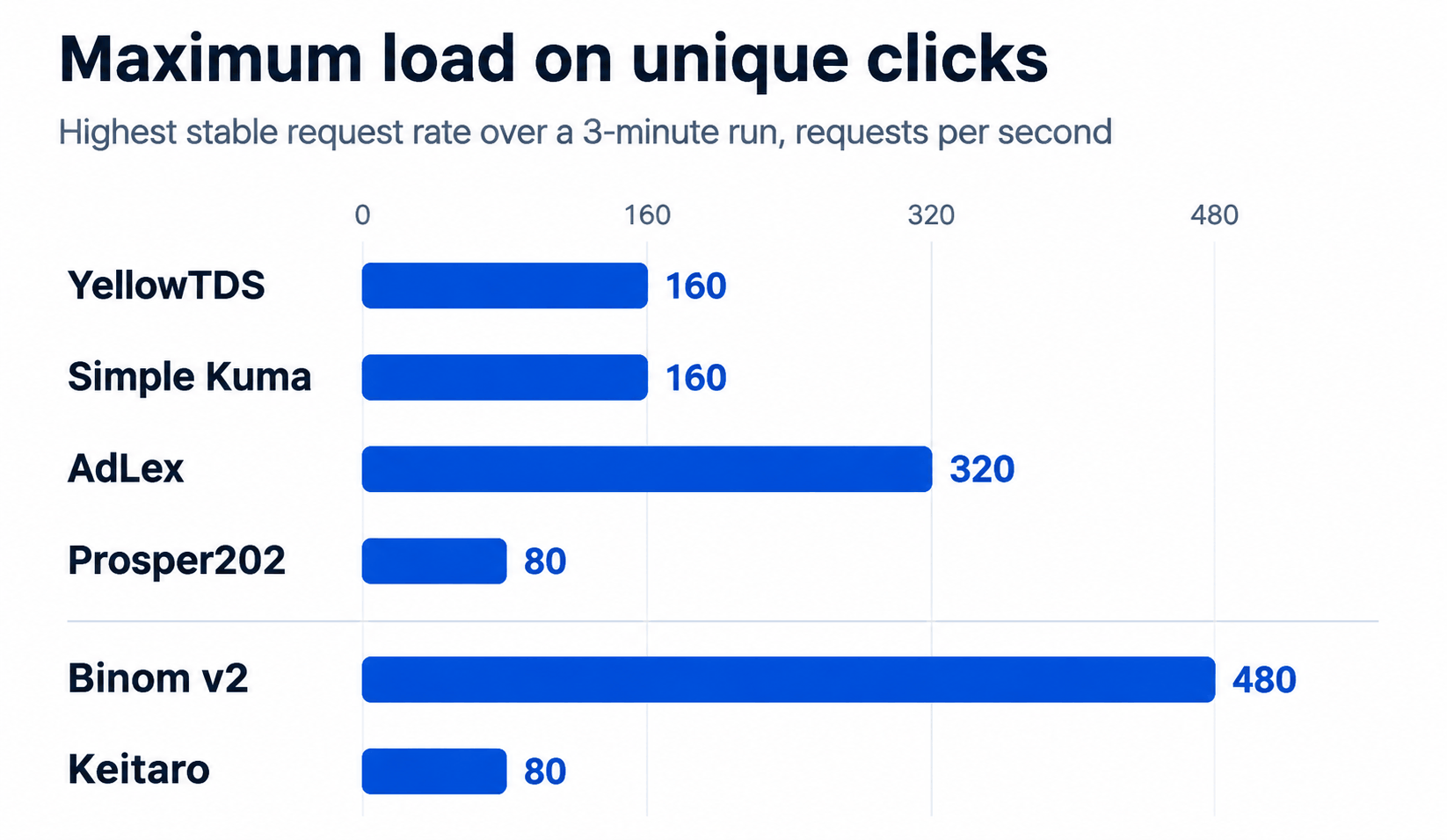
Under unique-click load, the leader remained Binom v2 (the CPARIP promo code gives you a free month and a 40% discount), which handled 480 requests/sec in the previous tests. Among the four new trackers, AdLex reached the highest step, YellowTDS handled the highest load across all three runs, and Simple Kuma responded the fastest at 160 requests/sec, but it lost clicks due to generating duplicate identifiers. Prosper202 passed the same 80 requests/sec step as Keitaro.
- AdLex passed the 320 requests/sec step in two of three runs, losing 1 click in the third. In the successful runs, 99% of requests completed within 843-848 ms. No test passed at 480 requests/sec.
- YellowTDS passed the 160 requests/sec step in all three repeats. 99% of requests completed within 256-443 ms at an average CPU load of 96-97%. At 320 requests/sec, correct redirects stopped, while average CPU usage approached 100%. After reducing the load to 20 requests/sec, all runs with repeated clicks recovered without errors.
Simple Kuma passed the 160 requests/sec step in two of three runs, with 99% of requests completing within 22-24 ms. In the third run, the tracker assigned an already used
click_idto one of 28,800 clicks, and its database rejected the record.Over the entire test series, 11 clicks were not recorded because the tracker generated an already used
click_idagain. These clicks would still have reached the landing page, but with theclick_idof a previously saved click. If a conversion came in with that identifier, it could have been attributed to the old click.- Prosper202 passed 80 requests/sec in all three runs. Mass timeouts began at 160 requests/sec, while clicks from timed-out requests were still saved in the database.
In an additional repeated-click test, YellowTDS, Simple Kuma, and AdLex successfully passed the 160 requests/sec step in all three repeats, while Prosper202 successfully passed the 80 requests/sec step. Recall that Keitaro handled only 40 requests/sec, and at 80 requests/sec all requests ended in a timeout or HTTP 500 error.
What Load the Trackers Handled
The table shows the maximum load steps each tracker handled when processing unique and repeated clicks.
| Tracker | Unique | Repeated | Start of Overload |
|---|---|---|---|
| YellowTDS | 160 | 160 | 320 in both profiles |
| Simple Kuma | 160 | 320 | 320 for unique clicks, 480 for repeated clicks |
| AdLex | 320 | 320 | 480 in both profiles |
| Prosper202 | 80 | 80 | 160 in both profiles |
| Binom v2 | 480 | 80 (not tested higher) | For unique clicks, first timeouts at 640, mass failures at 800-960 |
| Keitaro | 80 | 40 | For unique clicks, errors from 160; at 320, not a single correct redirect. For repeated clicks, none at 80 |
Response Time and CPU Usage
Comparative CPU load table at these steps: 160 requests/sec for unique clicks and 80 requests/sec for repeated clicks. p99 is the time within which 99% of requests completed, including errors and timeouts. CPU is the average server load during the measured period.
| Tracker | Unique, 160 requests/sec | Repeated, 80 requests/sec |
|---|---|---|
| YellowTDS | 443 ms / 95.8% | 37 ms / 53.7% |
| Simple Kuma | 22 ms / 58.1% | 18 ms / 24.1% |
| AdLex | 349 ms / 23.4% | 118 ms / 11.6% |
| Prosper202 | 5.0 sec / 93.6% | 27 ms / 68.0% |
| Binom v2 | 14 ms / 24.4% | 17 ms / 7.5% |
| Keitaro | 5.0 sec / 82.9% | 5.0 sec / 98.8% |








Comments